

tldr: The open-weight models worth running for coding in October 2026 are Muse Spark Open, DeepSeek V4.1 Flash, MiniMax M3.1 Flash, and Kimi K3.1 Pro, whose weights are due by 4 November. You can use models like these for free, but the free tiers are small, and Google and some OpenRouter providers train on the prompts you send them. Most paid hosts charge the lab's list price, so off-peak hours, cache-read rates, and coding plans change your bill far more than your choice of host. If you'd rather have the models ship code than answer API calls, Buildful runs open-weight models as a background coding agent, with plans from $10 a month.
Which open-weight models are worth running in October 2026?
The four open-weight models worth running for coding in October 2026 are Muse Spark Open, DeepSeek V4.1 Flash, MiniMax M3.1 Flash, and Kimi K3.1 Pro. Three of them landed between 15 and 23 October: Muse Spark Open's weights on 15 October, DeepSeek's V4.1 Flash 1017 snapshot on 17 October, and MiniMax M3.1 Flash's weights on 23 October. Kimi K3.1 Pro's weights are due by 4 November. The table adds three earlier models for comparison, with prices per million tokens, input and output.
| Model | Released | License | Price | Where to run it |
| Muse Spark Open | 15 Oct 2026 | Muse Model License | $1.25 / $4.25 | Together, Fireworks, Ollama, Buildful |
| DeepSeek V4.1 Flash | 10 Sep 2026 (1017 snapshot: 17 Oct) | MIT | $0.15 / $0.60 off-peak, direct | DeepSeek, Together, Fireworks, Ollama, Cloudflare, OpenCode Go, Buildful |
| MiniMax M3.1 Flash | 23 Oct 2026 (weights) | MiniMax Community License | $0.15 / $0.60 | MiniMax, Together, OpenCode Go, Buildful |
| Kimi K3.1 Pro | Weights due by 4 Nov 2026 | Not yet published | Not yet published | Kimi API, OpenRouter, OpenCode Go, Buildful |
| GLM-5.3 | Already shipping | GLM-5.3 License | $1.40 / $4.40 | Z.ai, Together, Fireworks, Ollama, Cloudflare, OpenCode Go, Buildful |
| GLM-5.3-Flash | Already shipping | MIT | $0.15 / $0.50 | Z.ai, Together, Fireworks, Ollama, Cloudflare, OpenCode Go, Buildful |
| Qwen3.8-27B | August 2026 | Apache 2.0 | $0.45 / $3.20 on Cloudflare | Cloudflare, Groq, Cerebras |
If you want a model with no conditions attached, pick DeepSeek V4.1 Flash. The 1017 snapshot is MIT-licensed and has a one-million-token window, and it costs $0.30 and $1.20 at every host that serves it, or half that off-peak on DeepSeek's own API.
The other October releases come with license conditions you should read before you build on them. Meta's Muse Spark Open has 816 billion parameters, 42 billion of them active, and takes text, image, video, and audio input. Its license requires every product built on it to display "Built with Muse Spark Open", and a model-as-a-service business past $20 million a year needs a separate deal with Meta.
MiniMax pitches M3.1 Flash at coding, agents, and computer use for $0.15 and $0.60. Its license asks for a "Built with MiniMax M3.1-Flash" notice and a one-time email to MiniMax before commercial use, and for written permission once your revenue passes $20 million.
Kimi K3.1 Pro is the largest of the four and the least settled. Moonshot calls it its "most capable 3T-class open-weight model" and bills it at a flat rate, with no surcharge for filling its one-million-token window. The weights aren't public yet, though. The quickstart promises them by 4 November, and until then Together, Fireworks, DeepInfra, Ollama, and Cloudflare don't serve it. If its license follows Kimi K3's, expect revenue gates there too.
Among the models that shipped before October, GLM-5.3 is the one Z.ai's own card calls "the most capable open-weights model for coding". Its license asks for a security review only from API businesses past $10 billion in revenue, which leaves out almost everyone reading this. Qwen3.8-27B is the small, permissive pick, a compact dense model under Apache 2.0. For a ranked list of every open-weight model you can download, with license terms and vendor scores, see our 10 best open-weight LLMs for coding.
Which free tiers are actually free?
Several platforms give you open-weight models for $0, and each one comes with a catch that the table spells out. Every figure below comes from the provider's own pricing or limits page, read on 27 October 2026.
| Platform | What you get for $0 | The catch |
| Gemini API | Gemma 4, input and output free of charge | Free-tier prompts are used to improve Google's products. There is no paid tier for Gemma, so no way to opt out |
| OpenRouter | 25-plus :free models at 20 requests a minute | 50 requests a day until your account has bought $10 of credits, then 1,000. Failed attempts count against the cap |
| Groq | gpt-oss-120b, gpt-oss-20b, and Qwen3.8 27B | Limits are set per model on Groq's rate-limits page. The billing FAQ asks for a card when you upgrade to Developer |
| Cloudflare Workers AI | 10,000 neurons a day, reset at 00:00 UTC | That's $0.11 a day at the paid rate. The newest Kimi, GLM, and DeepSeek models require a paid billing method |
| NVIDIA build.nvidia.com | Hosted DeepSeek V4.1 Flash and Nemotron models, among others | NVIDIA pitches the endpoints for prototypes and publishes no rate limits |
| OpenCode Zen | Free GLM-5.3-Flash, DeepSeek V4.1 Flash, and others | Free for a limited time, and free models work only inside the OpenCode agent |
| Cerebras | A one-time $5 credit | Requires a payment method, expires after 30 days, capped at 1 million tokens a day. The FAQ says there is no permanently free tier |
| Hugging Face | Nothing monthly on a free account | Free users must buy credits. PRO costs $9 a month and includes $2 of inference |
| Ollama | Unlimited local models | Cloud models bill per token from the first one |
GitHub Models is missing from that table on purpose, because GitHub fully retired it on 30 July 2026, including the playground, catalog, and inference API.
Two of these free tiers stand out from the rest. Gemma 4 on the Gemini API is the only option where a capable open-weight model costs nothing at any volume the rate limiter allows, as long as you're comfortable with Google reading your prompts.
The other is OpenRouter, where the $10 threshold is the best $10 in this article. Buying $10 of credits lifts the free-model cap from 50 requests a day to 1,000, and you keep the credits to spend on paid models.
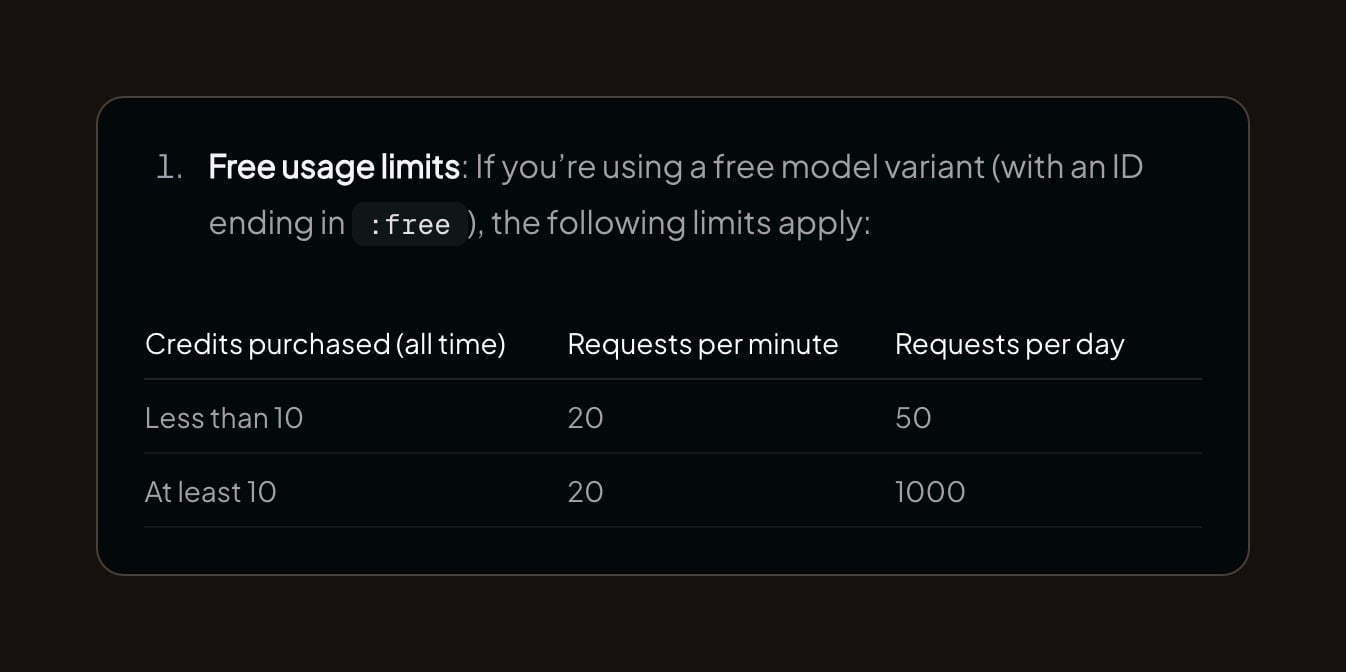
OpenRouter's limits on free models. Screenshot: OpenRouter docs (openrouter.ai), 27 October 2026.
OpenRouter's free roster is a different set of models from the ones in the first table, though. The free collection is led by NVIDIA's Nemotron family, Poolside's Laguna, and Thinking Machines' Inkling, the open-weight model from our fine-tuning guide, and DeepSeek, GLM, and Kimi aren't on it.
Read the model card before you send anything private. Poolside says it "may use your inputs and outputs to train" when you use Laguna for free, and Liquid's card says prompts to LFM2.5 may be retained for training.
Cloudflare's allowance is easier to judge once you turn it into tokens. At gpt-oss-120b's paid rates, $0.11 a day buys about 314,000 input tokens or 147,000 output tokens, which is enough for a hobby project. The sample agent month in the cost section reads about 3.3 million input tokens a day, ten times what the allowance covers.
Does the host change the price?
For the most part, the host doesn't change the price. If you line up the same model across hosts, the rates are usually identical to the cent, because most hosts match the lab's own list rate. Prices are per million tokens, input and output.
| Model | Lab's own API | Together | Fireworks | DeepInfra | Ollama | Cloudflare |
| GLM-5.3 | $1.40 / $4.40 | $1.40 / $4.40 | $1.40 / $4.40 | not listed | $1.40 / $4.40 | $1.40 / $4.40 |
| Muse Spark Open | none | $1.25 / $4.25 | $1.25 / $4.25 | not listed | $1.25 / $4.25 | not listed |
| DeepSeek V4 Pro | $1.32 / $3.96 | $1.32 / $3.96 | not listed | $1.30 / $2.60 | $1.32 / $3.96 | $1.32 / $3.96 |
| DeepSeek V4.1 Flash | $0.30 / $1.20 | $0.30 / $1.20 | $0.30 / $1.20 | not listed | $0.30 / $1.20 | $0.30 / $1.20 |
| Kimi K3 | $3 / $15 | $3 / $15 | $3 / $15 | $2.85 / $14.25 | $3 / $15 | not listed |
| gpt-oss-120b | none | $0.15 / $0.60 | $0.15 / $0.60 | not listed | $0.15 / $0.60 | $0.35 / $0.75 |
Sources: Z.ai, DeepSeek, Together, Fireworks, DeepInfra, Ollama, and Cloudflare. The DeepSeek figures are its peak rates, and the Kimi K3 lab price comes from our launch coverage, because Moonshot's own pricing table rendered empty on 27 October.
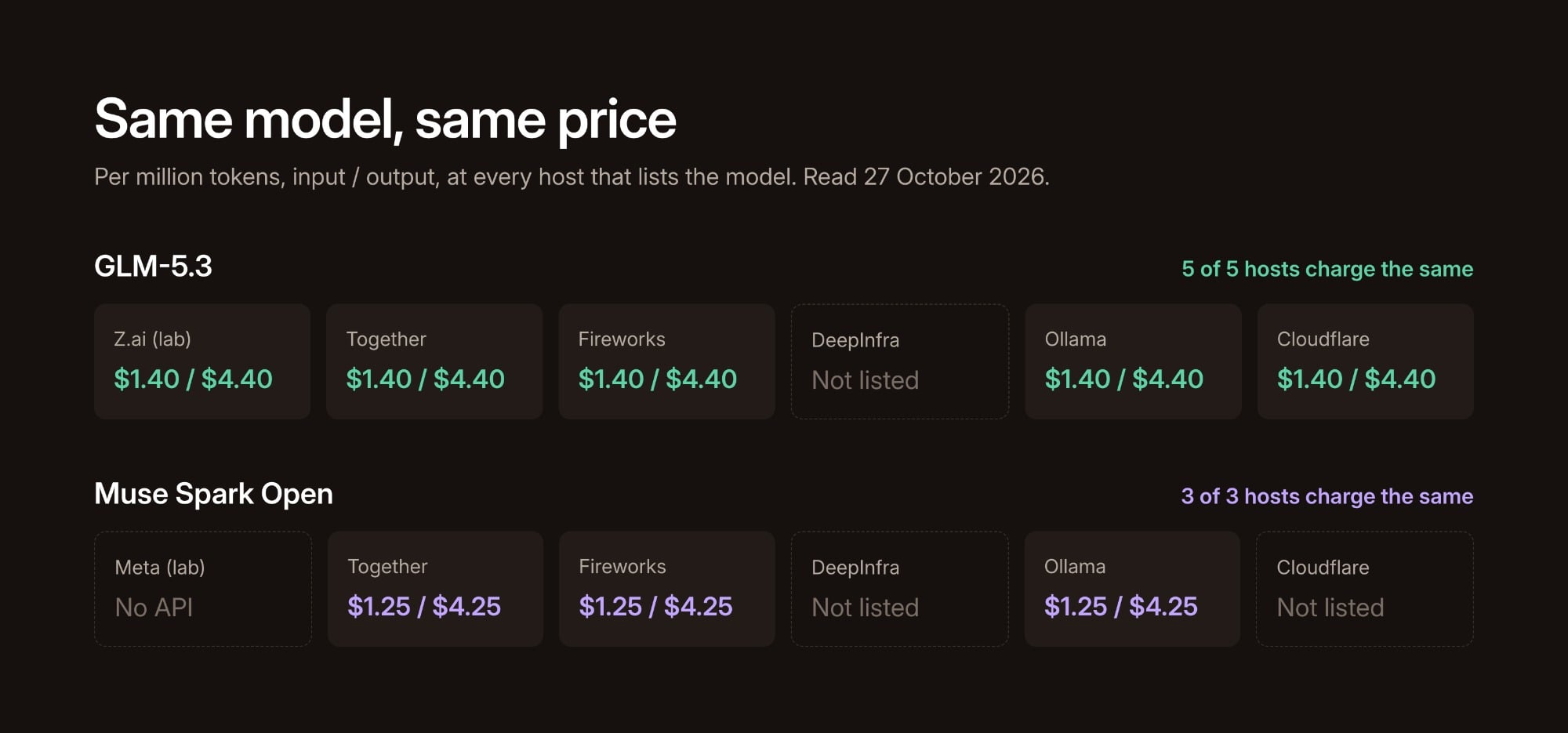
GLM-5.3 and Muse Spark Open cost the same at every host that lists them. Prices read on 27 October 2026.
GLM-5.3 costs the same at five hosts, and Muse Spark Open costs the same at all three hosts that list it. That means asking which host charges least won't get you far. The better questions are which host is fastest, which one serves the model you need, and how each one bills cache reads.
Speed is the one place where the hosts pull apart. Cerebras lists gpt-oss-120b at about 3,000 tokens a second and charges $0.35 and $0.75 for it, while Groq lists the same model at 500 tokens a second for $0.15 and $0.60. You pay a little more than double on input to go six times faster, which is a good trade for an agent loop that waits on every response.
DeepInfra is the exception on price. Its DeepSeek V4 Pro output costs 34% less than everyone else's, and it still serves the July snapshot of V4 Flash at $0.06 and $0.18. On agent traffic, though, that output discount buys less than it seems, for reasons the next section shows.
What actually cuts the bill?
Three things cut an open-weight bill more than the host does: off-peak hours, cache-read rates, and the model you choose. To see how much each one moves, take one illustrative month of coding-agent traffic with 100 million input tokens, 80 million of them cache hits, and 3 million output tokens. That shape is normal for agents, because they reread the same repository context on every turn, which makes the input side heavy and the cache-hit rate high.
| Setup | Cost for the month |
| Kimi K3 on Together or Fireworks | $129.00 |
| GLM-5.3 on any host above | $62.00 |
| DeepSeek V4 Pro on Together | $48.68 |
| DeepSeek V4 Pro on DeepInfra | $41.80 |
| DeepSeek V4 Pro direct, peak hours | $41.80 |
| DeepSeek V4 Pro direct, off-peak | $20.90 |
| DeepSeek V4.1 Flash direct, peak hours | $10.08 |
| MiniMax M3.1 Flash direct | $6.00 |
| DeepSeek V4.1 Flash direct, off-peak | $5.04 |
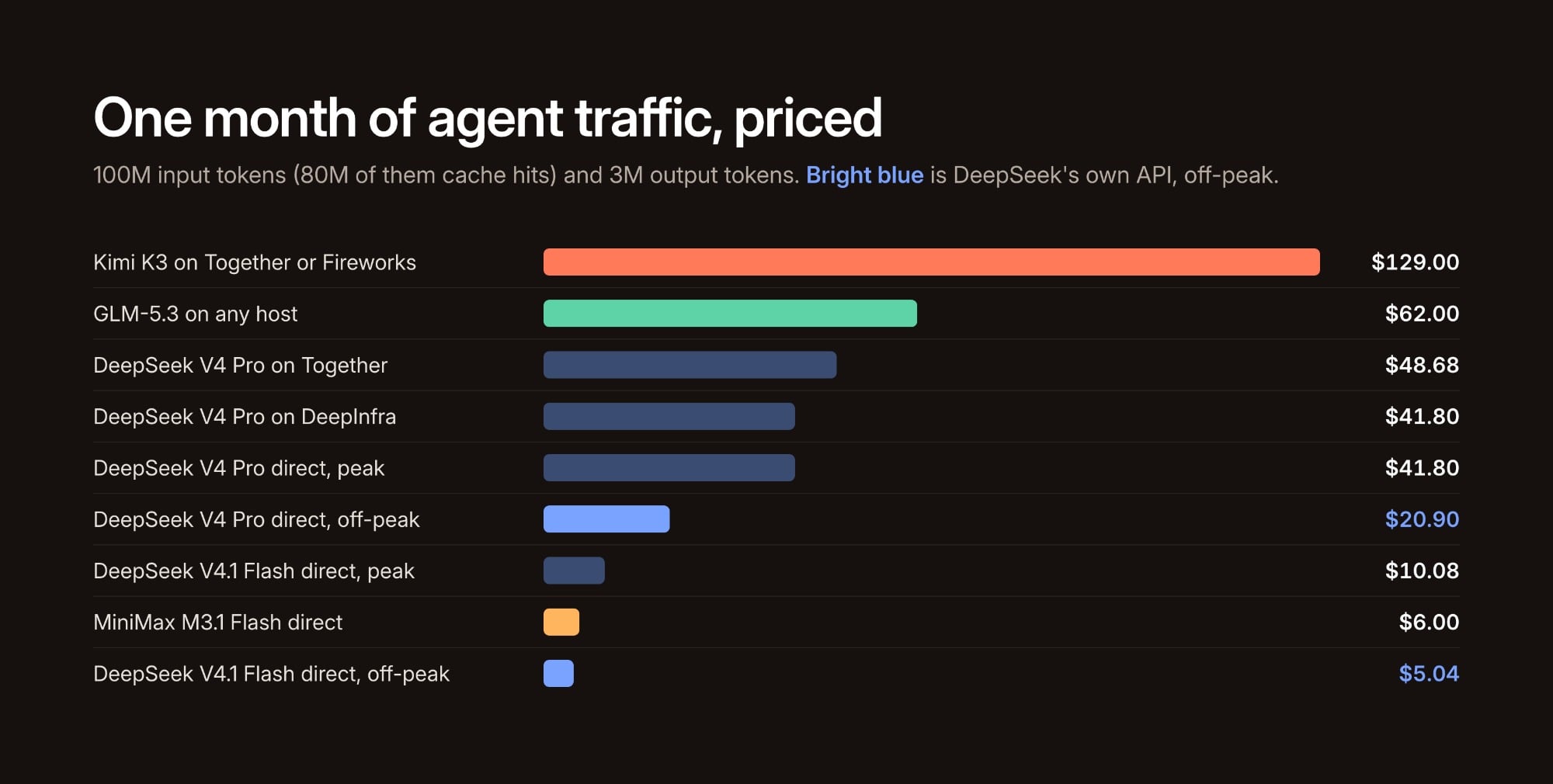
One month of coding-agent traffic (100M input tokens, 80M of them cached, and 3M output tokens) priced on each setup.
The first lever is timing, because DeepSeek's own API charges half price off-peak. Peak hours run 01:00 to 04:00 and 06:00 to 10:00 UTC on weekdays, which is 35 of the week's 168 hours. The other 79% of the week is off-peak, including a full 9am to 5pm working day on either US coast. For an American team, that makes V4 Pro effectively cost $0.66 and $1.98, which no other host in this article matches.
Check one thing before you plan around that rate. DeepSeek's 10 September note says every deepseek-v4-pro request now routes to V4.1 Flash at Flash rates until V4.1 Pro launches, and that V4 Pro is being phased out, while its pricing page still lists V4 Pro at its own rates. If you use Ollama instead, it runs its own off-peak discount on DeepSeek models on a different window: outside 12:00 to 18:00 UTC on weekdays, and all weekend.
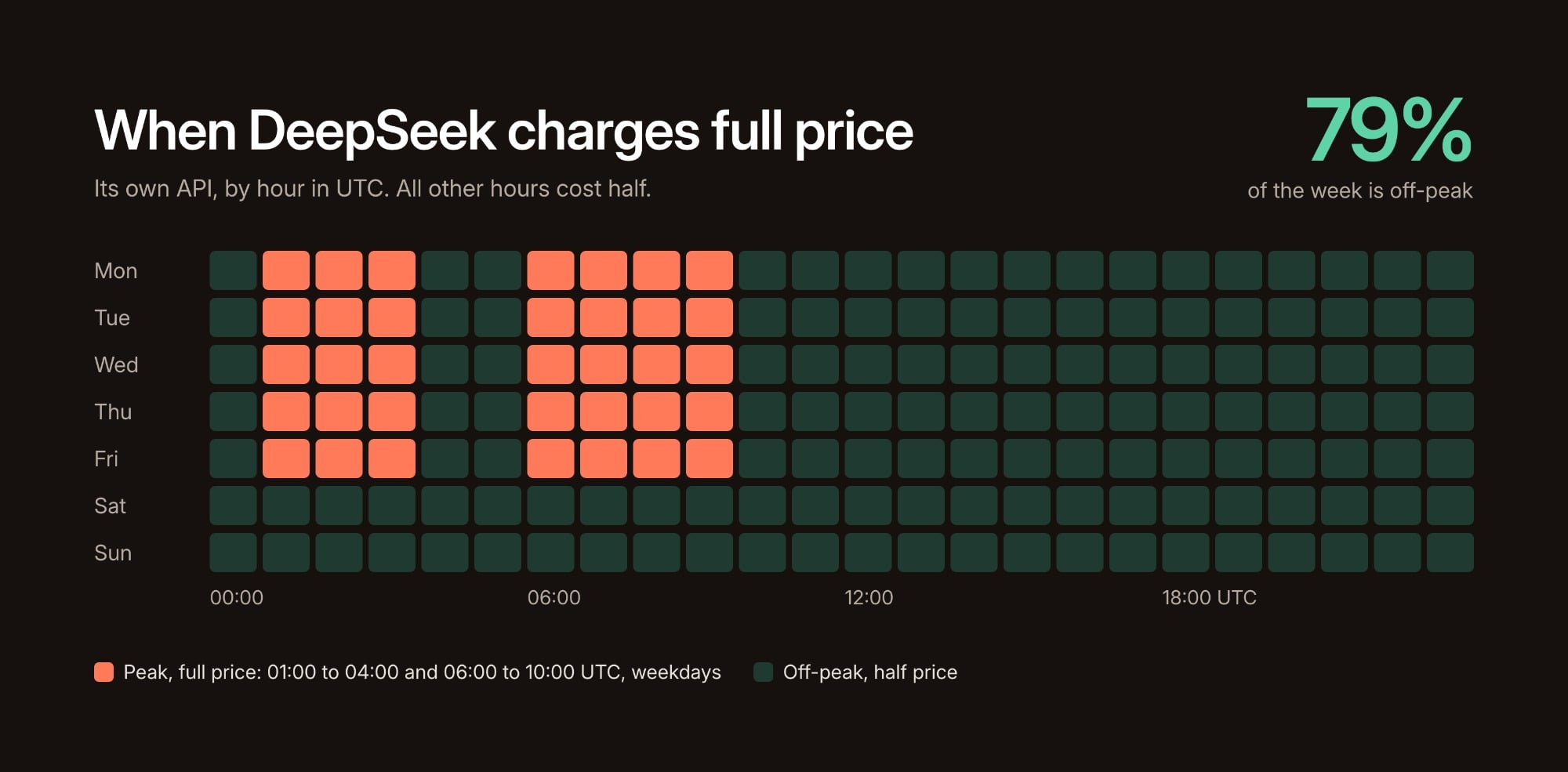
DeepSeek's own API charges full price for 35 of the week's 168 hours.
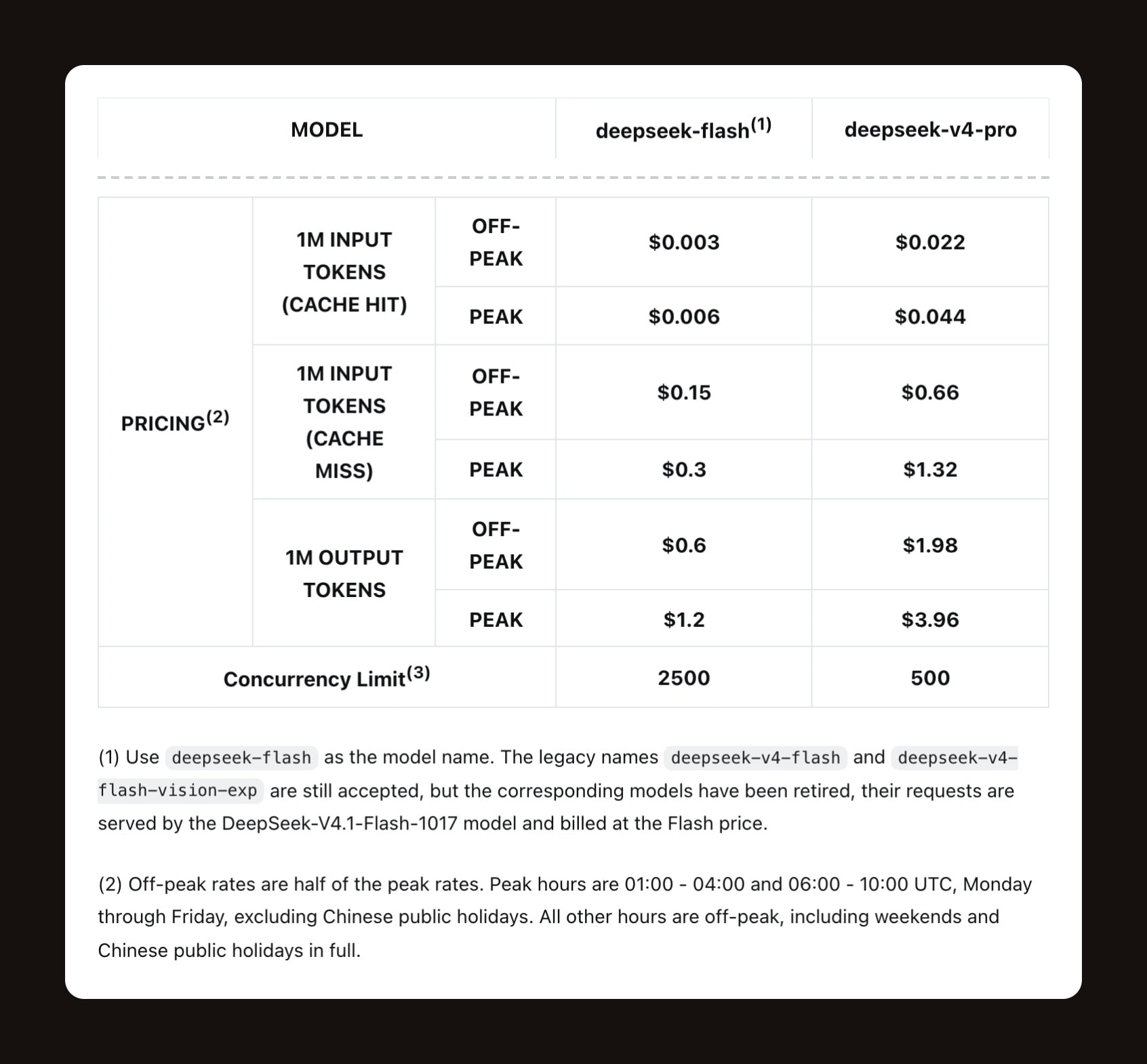
DeepSeek's off-peak and peak rates, with the middle rows trimmed. Screenshot: DeepSeek API Docs (api-docs.deepseek.com), 27 October 2026.
The second lever is cache reads, and on agent traffic they can decide the bill. DeepInfra's 34% output discount on V4 Pro lands at exactly the same $41.80 as DeepSeek's peak rate, because DeepInfra charges $0.10 per million for cache reads against DeepSeek's $0.044. Together charges $0.13, which is why the same model costs 16% more there.
When 80% of your input is cached, the cache-read column outweighs the output column. Check it before you switch hosts for a headline rate.
The third lever, and the biggest, is the model itself. On this workload, V4.1 Flash off-peak costs a quarter of V4 Pro off-peak, and Kimi K3 costs six times as much as V4 Pro off-peak. If one of the Flash models handles your task, that saving dwarfs everything above. Our LLM API pricing comparison makes the same point for closed models: pick the tier from the task, then compare prices inside it.
Are coding plans cheaper than paying per token?
Yes, coding plans beat per-token pricing by a wide margin, as long as you stay inside each plan's rules.
Z.ai's GLM Coding Plan starts at $18 a month. Its entry tier, Lite, allows 2,000 credits per five hours and 10,000 a week. Z.ai also publishes how it converts tokens to credits: input tokens times 6.9, plus cached input times 1.7, plus output times 24, all divided by 10,000.
If you run the workload above through that formula, it comes to 34,600 credits, and Lite allows about 43,300 a month. The same tokens cost $62 at GLM-5.3's API rate, and at this traffic mix the full Lite allowance is worth about $78 at list price. Off-peak usage, outside 14:00 to 18:00 Singapore time on weekdays, burns credits at half rate.
Z.ai's FAQ lists the catches. The plan works only with supported tools such as Claude Code, Codex, OpenCode, and Cline, and subscriptions are non-refundable. The five-hour window also caps bursts at about 61 requests of 30,000 uncached input and 5,000 output tokens.
OpenCode Go costs $10 a month and covers 30 models, open and closed, including Kimi K3.1 Pro, MiniMax M3.1 Flash, DeepSeek V4.1 Flash, GLM-5.3, and Qwen3.8 Max. Each model gets its own monthly dollar budget, from $80 of DeepSeek V4.1 Flash and $20 of MiniMax M3.1 Flash down to $15 each of GLM-5.3 and Kimi K3.1 Pro. Any five-hour window can use 20% of a model's budget, and any week can use 50%. It works with other coding agents and exposes OpenAI-compatible endpoints, though OpenCode says it monitors traffic for abuse and wants agent-shaped requests.
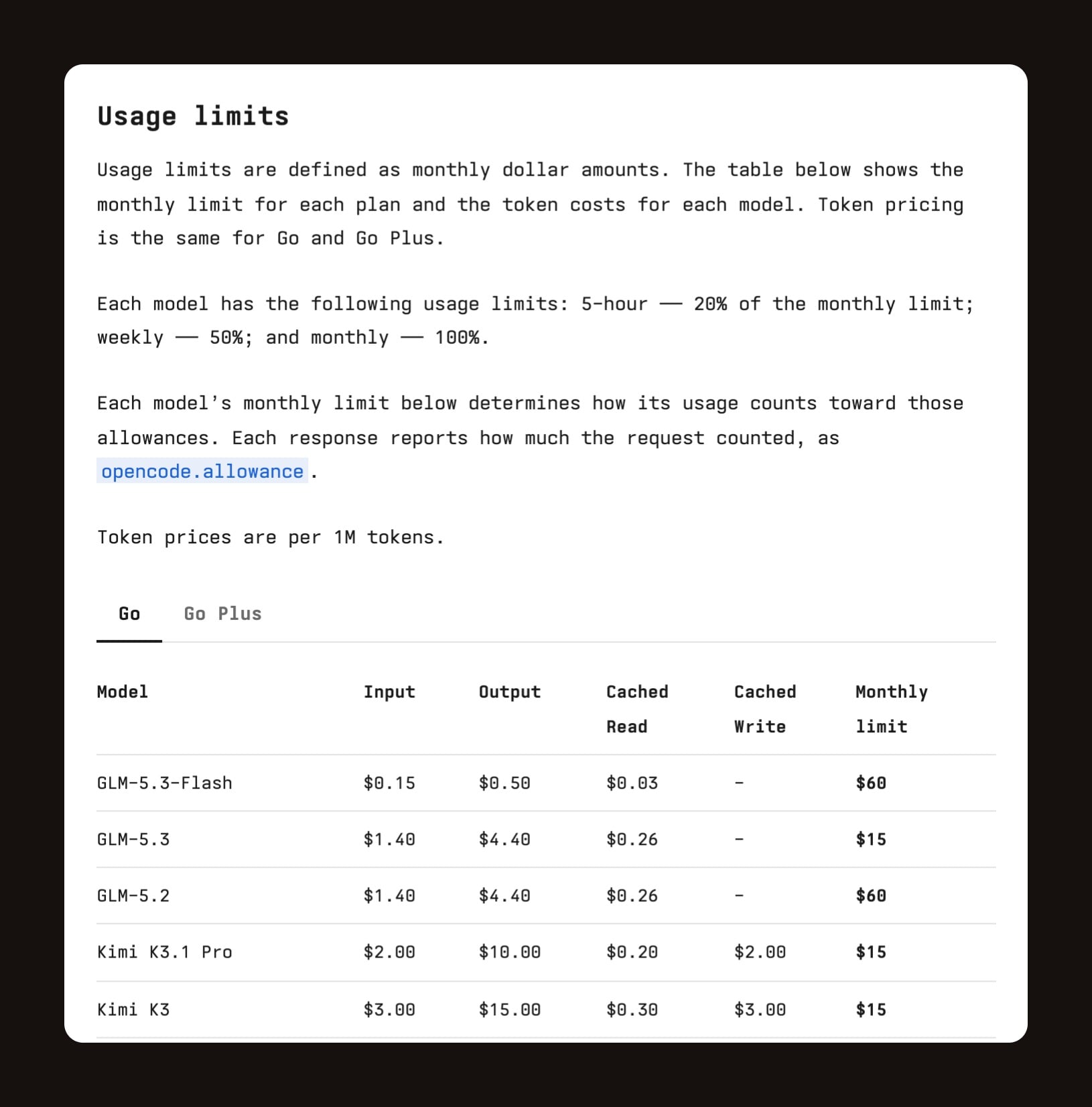
Per-model monthly limits on OpenCode Go. Screenshot: OpenCode docs (opencode.ai), 27 October 2026.
Ollama sells the same idea with less fine print. Pro costs $20 a month and includes $60 of usage credits at its normal per-token rates, and Max costs $100 and includes $300. Either way you get three times face value on any cloud model Ollama hosts, Muse Spark Open, GLM-5.3, and DeepSeek V4 Pro included. Unused credit doesn't roll over.
MiniMax and Moonshot sell their own coding plans too, but neither publishes a token figure. MiniMax's M Plan describes its Explore and Build tiers as 3 and 7.5 times the usage of Go, and Kimi Code meters usage on a rolling five-hour window.
What if you want the code written, not an API?
If you want the code written for you, Buildful is an AI coding agent that does the work: you describe a change, and it builds it, tests it in a real browser, and opens a pull request on your GitHub repo. Every option above still leaves you to wire up the agent, the sandbox, the test run, and the review, which is fine if you already live in Claude Code. Buildful is a Claude Code alternative for when you have a GitHub repo and a backlog and want nothing to assemble.
It's a background coding agent that runs open-weight models in the cloud, so there's no GPU, no API key, and nothing running on your laptop. It works like a small AI software factory: a task goes in, a tested pull request comes out, and you can close the tab while it works.
You start a task in the browser, Slack, or Linear. Buildful works on your repo in a private cloud sandbox that's deleted when the task ends, runs your lint, type checks, and tests, and fixes what fails. It tests UI changes in a real browser and records the run, so the pull request comes back with the recording attached. Nothing reaches your main branch until you merge it.
By default, Buildful picks an open-weight model for each task. On a paid plan you can choose one yourself, and the picker already carries the October releases: Muse Spark Open, DeepSeek V4.1 Flash, MiniMax M3.1 Flash, and Kimi K3.1 Pro, alongside GLM-5.3, GLM-5.3-Flash, and Kimi K3. Frontier models are there too, on prepaid credit, for the tasks that need them.
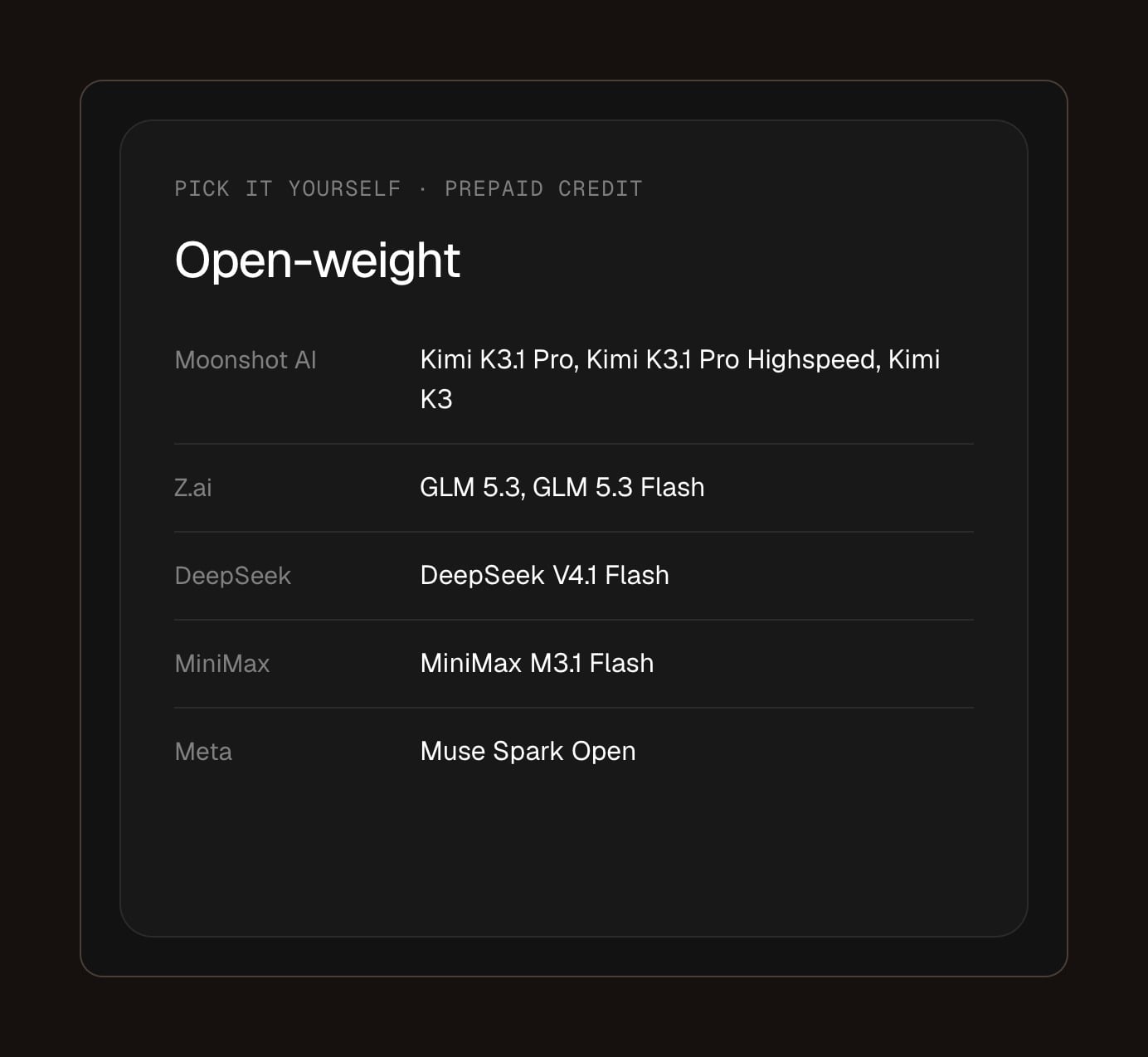
The open-weight models you can pick on Buildful's paid plans. Screenshot: Buildful (buildful.ai), 27 October 2026.
Pricing starts at $10 a month for Pro, which covers 1,000 tasks and works out to about a cent a task. Team costs $40 for 3,000 tasks shared by everyone on it. Those tasks run on Smart Mode, where Buildful picks the open-weight model for each one.
If you'd rather choose the model yourself, that usage is paid from prepaid credit. The $30 Buildful Pass adds $80 of usage a month on four models: Kimi K3, DeepSeek V4.1 Flash, GLM-5.3 Flash, and MiniMax M3.1 Flash.
You can try three tasks free, with no card, and Buildful's privacy policy says it doesn't use your code or task content to train models. It's the wrong tool if you need an API key for your own product or a base URL to point Claude Code at, because Buildful offers neither.
How do you point Claude Code at an open-weight model?
You point Claude Code at an open-weight model by setting two environment variables, because Z.ai, MiniMax, and Moonshot all run Anthropic-compatible endpoints and Claude Code needs no other change. Here's the Z.ai version:
export ANTHROPIC_BASE_URL=https://api.z.ai/api/anthropic
export ANTHROPIC_AUTH_TOKEN=your-zai-api-key
claude
MiniMax's base URL is https://api.minimax.io/anthropic, and Kimi's overseas endpoint is https://api.kimi.ai/coding/. Z.ai's setup page and MiniMax's also show how to map Claude Code's model slots to their models. Once the variables are set, requests stop drawing on your Anthropic plan, so this doubles as a way around Claude Code's usage limits.
For everything else, an OpenAI-compatible client and OpenRouter cover the most ground with one key. OpenRouter doesn't mark up provider rates, but it charges 5.5% when you buy credits, so routing $100 of usage through it costs $105.50.
Can you run them locally for free?
Yes, you can run the smaller ones locally for free if you own the hardware, since Ollama's local runtime is MIT-licensed and unmetered. OpenAI says gpt-oss-20b runs in 16 GB of memory, which puts it on a recent laptop, and Qwen3.8-27B is a 27-billion-parameter dense model that its card calls deployment-friendly. Our guide to the best local LLMs for coding sorts every model that fits by how much memory you have.
The October releases are a different story. Muse Spark Open is 816 billion parameters and Kimi K3's weights alone are about 1.56 TB, so self-hosting either one means renting or owning a GPU cluster.
Which one should you pick?
The right model and host depend on what you're trying to do, so the table gives one pick for each goal.
| If you want | Pick |
| Open-weight models doing coding work, nothing to set up | Buildful. Hand it a task and review the pull request |
| Zero spend for a prototype | Gemma 4 on the Gemini API if Google training on your prompts is acceptable. Otherwise put $10 into OpenRouter and use the free models at 1,000 requests a day |
| A plan for the coding agent you already use | OpenCode Go for the most models, the GLM Coding Plan if GLM is all you need, Ollama Pro for credits that work on any model it hosts |
| Pay-per-token agent traffic | DeepSeek V4.1 Flash on DeepSeek's own API during off-peak hours |
| Low latency in an agent loop | gpt-oss-120b on Cerebras |
| The lowest price for a capable model | DeepSeek V4.1 Flash off-peak or MiniMax M3.1 Flash, both at $0.15 and $0.60 |
FAQ
Is there a completely free API for open-weight models?
Yes, several APIs serve open-weight models for free, though all of them have limits. Gemma 4 is free of charge on the Gemini API, OpenRouter offers more than 25 free models, Groq has a free plan for gpt-oss and Qwen3.8 27B, and Cloudflare gives you 10,000 neurons a day. Google uses free-tier prompts to improve its products, and some OpenRouter providers train on free traffic.
Where can I use Kimi K3.1 Pro for coding?
You can use Kimi K3.1 Pro through Moonshot's own API and Kimi Code plan, OpenRouter, OpenCode Go, and Buildful's model picker on Pro and Team, where it's paid from prepaid credit. As of 27 October 2026, Together, Fireworks, DeepInfra, Ollama, and Cloudflare don't serve it. Moonshot says the full weights will be released by 4 November, and more hosts should follow after that.
Is there a Claude Code alternative that runs on open-weight models?
Yes, Buildful is an AI coding agent that runs open-weight models in the cloud. You describe a change, and it builds it, runs your checks, tests UI changes in a real browser, and opens a pull request on your GitHub repo. Pro costs $10 a month for 1,000 tasks on Smart Mode, where Buildful picks the model for you. On paid plans you can also pick models like Kimi K3.1 Pro, GLM-5.3, and DeepSeek V4.1 Flash yourself, paid from prepaid credit. You can try three tasks free, with no card.
Is there a subscription for open-weight coding models?
Yes, several plans charge a flat monthly fee for open-weight coding models. OpenCode Go costs $10 a month with a per-model budget, Z.ai's GLM Coding Plan starts at $18, and Ollama Pro costs $20 with $60 of credits. Buildful costs $10 a month for 1,000 tasks, and its $30 Pass adds $80 of usage on four open-weight models.
Is OpenRouter more expensive than going direct?
OpenRouter costs more than going direct only by its credit fee. Inference bills at the provider's list price, and OpenRouter adds 5.5% when you buy credits on the standard plan.
Is GitHub Models still free?
No, GitHub retired GitHub Models entirely on 30 July 2026. Its docs point to Azure AI Foundry and GitHub Copilot instead.
About the author
Co-founder, Hashnode and currently building Buildful and Bug0.


