This is a great distinction that more dev teams need to think about.
Traditional SEO focuses on getting human eyeballs to a page through search engine indexing. It relies on keyword density, metadata, backlink profiles, and visual page layout. You can afford some fluff or fancy marketing language on an SEO page as long as Google ranks it.
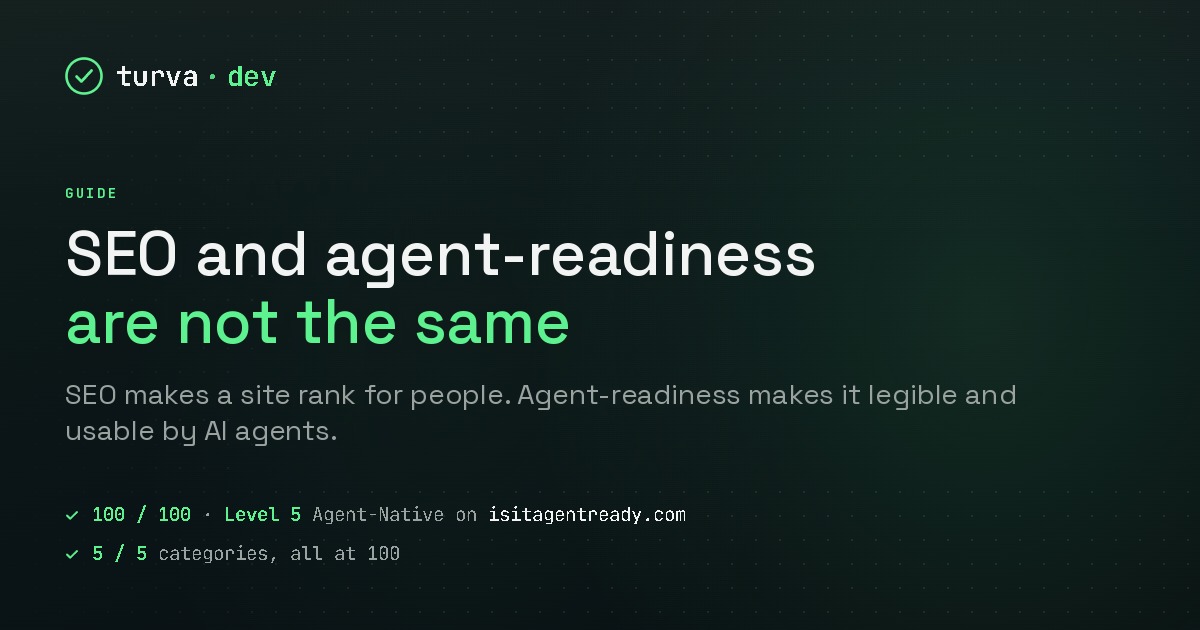
Agent-readiness is completely different. AI agents don't care about page authority or pretty CSS. They need structured, deterministic inputs. When an agent reads a site or API, fluff actually hurts because it fills up context windows with junk tokens and increases the risk of hallucinations.
A few quick differences I've noticed when building for agents:
Format: SEO likes HTML and styled pages. Agents prefer clean Markdown, JSON-LD, or direct OpenAPI specs so they can use functions accurately.
Intent: SEO drives traffic to a page for humans to read. Agent-readiness allows an AI to perform an action or extract precise facts without human intervention.
Data hygiene: SEO tolerates ambiguous language. Agents need strict schemas, clear API documentation, and well-defined parameters.
Are you looking at making your public web content readable by LLMs, or actually exposing tools/APIs for agents to execute actions? That usually dictates how far down the agent-readiness rabbit hole you need to go.
Both, and they sit at different layers. The readable layer is llms.txt, markdown and JSON-LD, so an agent can take in your facts without parsing HTML. The capability layer is a discoverable, authenticated API or MCP endpoint, so it can act on them. Most sites I scan have some of the first and nothing of the second. That gap is the usual one. I run turva.dev as the reference build for both, though its MCP side is read-only by design. Which one matters more comes down to whether you want an agent to know your facts or do something with them.
This is a great distinction that more dev teams need to think about.
Traditional SEO focuses on getting human eyeballs to a page through search engine indexing. It relies on keyword density, metadata, backlink profiles, and visual page layout. You can afford some fluff or fancy marketing language on an SEO page as long as Google ranks it.
Agent-readiness is completely different. AI agents don't care about page authority or pretty CSS. They need structured, deterministic inputs. When an agent reads a site or API, fluff actually hurts because it fills up context windows with junk tokens and increases the risk of hallucinations.
A few quick differences I've noticed when building for agents:
Are you looking at making your public web content readable by LLMs, or actually exposing tools/APIs for agents to execute actions? That usually dictates how far down the agent-readiness rabbit hole you need to go.