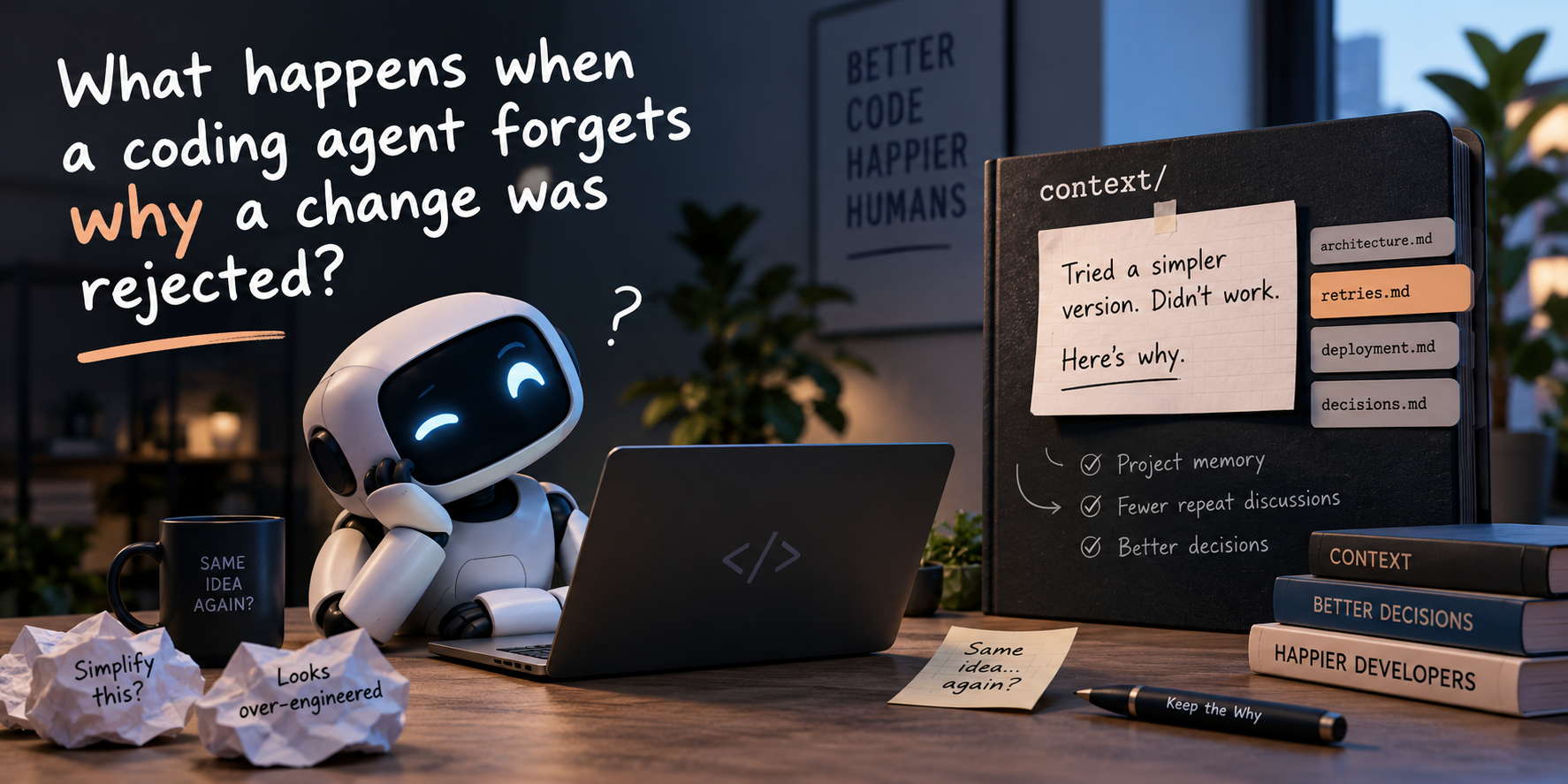
Great insight. AI coding agents need more than the ability to generate code, they need context and memory of past decisions. Understanding why a change was rejected is what will make them true engineering partners rather than just code assistants.
This is such an important discussion about the difference between intelligence and understanding. A coding agent can generate impressive solutions, but without remembering why certain decisions were made, it can easily repeat the same mistakes or reopen problems that humans have already solved. The real challenge with AI collaboration is not only making agents better at writing code, but helping them preserve the context, trade-offs, and lessons behind those decisions. In software development, the “why” is often just as valuable as the code itself. I think the future of AI-assisted development will depend less on replacing developers and more on creating AI partners that can learn from a team’s history, respect previous decisions, and understand the reasoning behind a system’s evolution. Great reminder that true collaboration requires memory, context, and trust, not just faster code generation.
The most useful distinction here is between code state and decision state. Git tells the next agent what survived, but it often cannot tell it which alternatives were deliberately killed along the way.
I’d take this one step further and treat rejected approaches as constraints with an expiration condition. A workaround may be rejected because of a production incident today, but that reason can become invalid after a dependency, architecture, or traffic pattern changes. Recording not just “don’t do this” but why, under which conditions, and when to revisit it would make project memory much more actionable.
That turns a simple Markdown file into something more valuable than context it becomes a lightweight record of architectural decisions and their assumptions.
The idea of preserving rejected decisions is especially interesting because it captures a form of “negative knowledge” that Git usually can’t represent. A codebase can show what the team chose, but not necessarily which alternatives were tested and ruled out. For coding agents, that context could prevent not only repeated mistakes but also repeated investigation. It makes project memory feel less like storing explanations and more like preserving the reasoning boundary around the code.
Julian Neagu
500+ AI tools shipped solo. Founder of VisionVix.
The rejected changes part is what stood out to me. Git is good at showing what we kept, but not what we tested and threw away. That missing history gets expensive once agents start working across sessions.