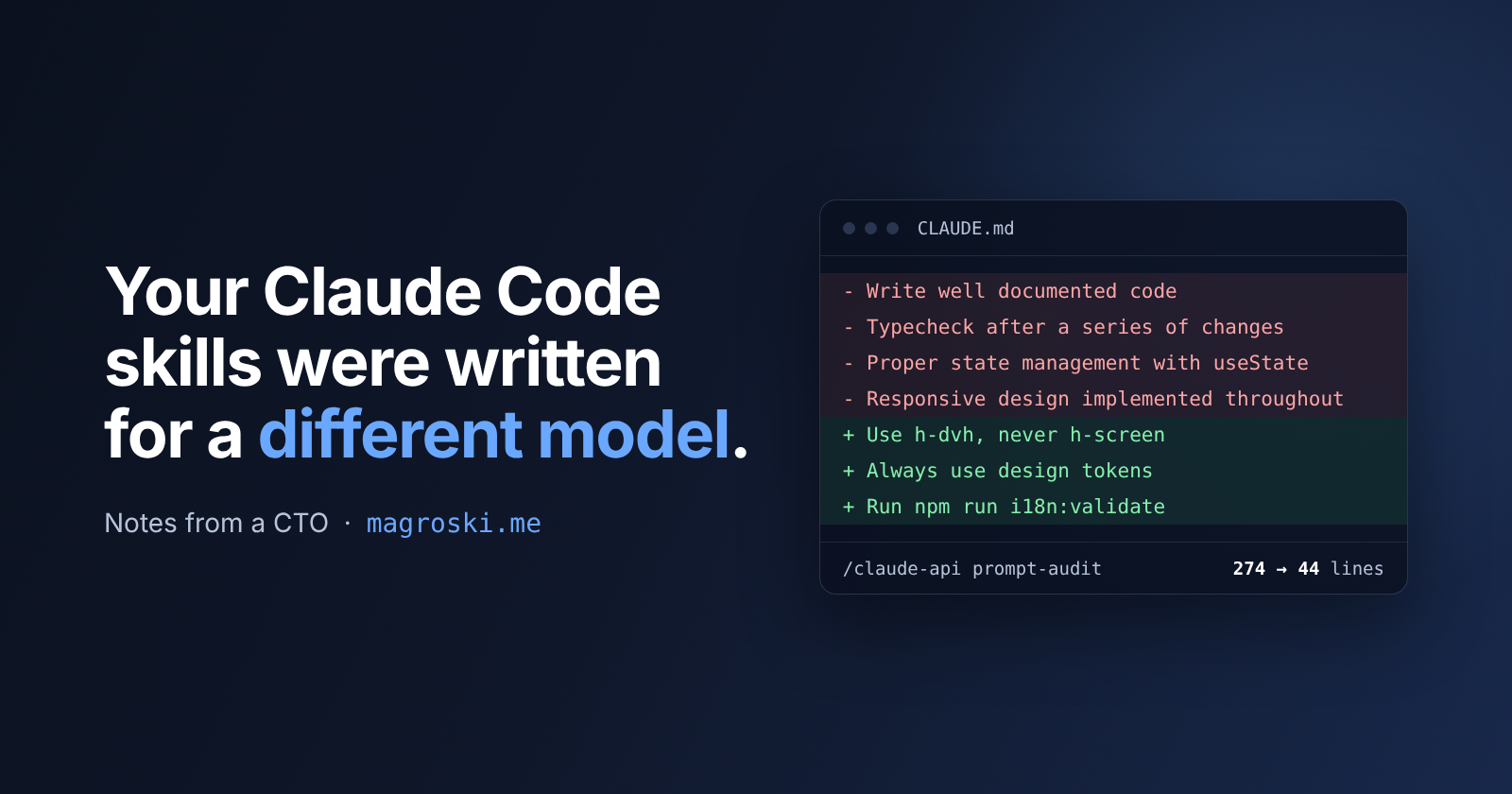
What did last year's skills lose when the model changed underneath them, the instructions or the thing the instructions were compensating for? A skill aimed at a weaker model often encodes the workaround rather than the task, so it reads as noise to a stronger one and you delete the wrong half. Turning a skill into validation the agent runs on its own output, rather than prose telling it to be careful, is hard to judge from a description. If a skill can't survive a model swap, it was probably describing the model rather than the job.
BomToBe
BOMTOBE makes orke, a desktop workspace for Claude Code and Codex.
Disclosure: I work in marketing at BOMTOBE, maker of orke, a workspace for Claude Code and Codex. A small model-upgrade regression set could preserve the reason for each rule: one task that once failed without it, the expected result, and any safety invariant. Rerun those same tasks against the old and new model; remove a line only after the replacement still passes. That makes the skill diff an auditable hypothesis rather than a cleanup based on one fresh demo.