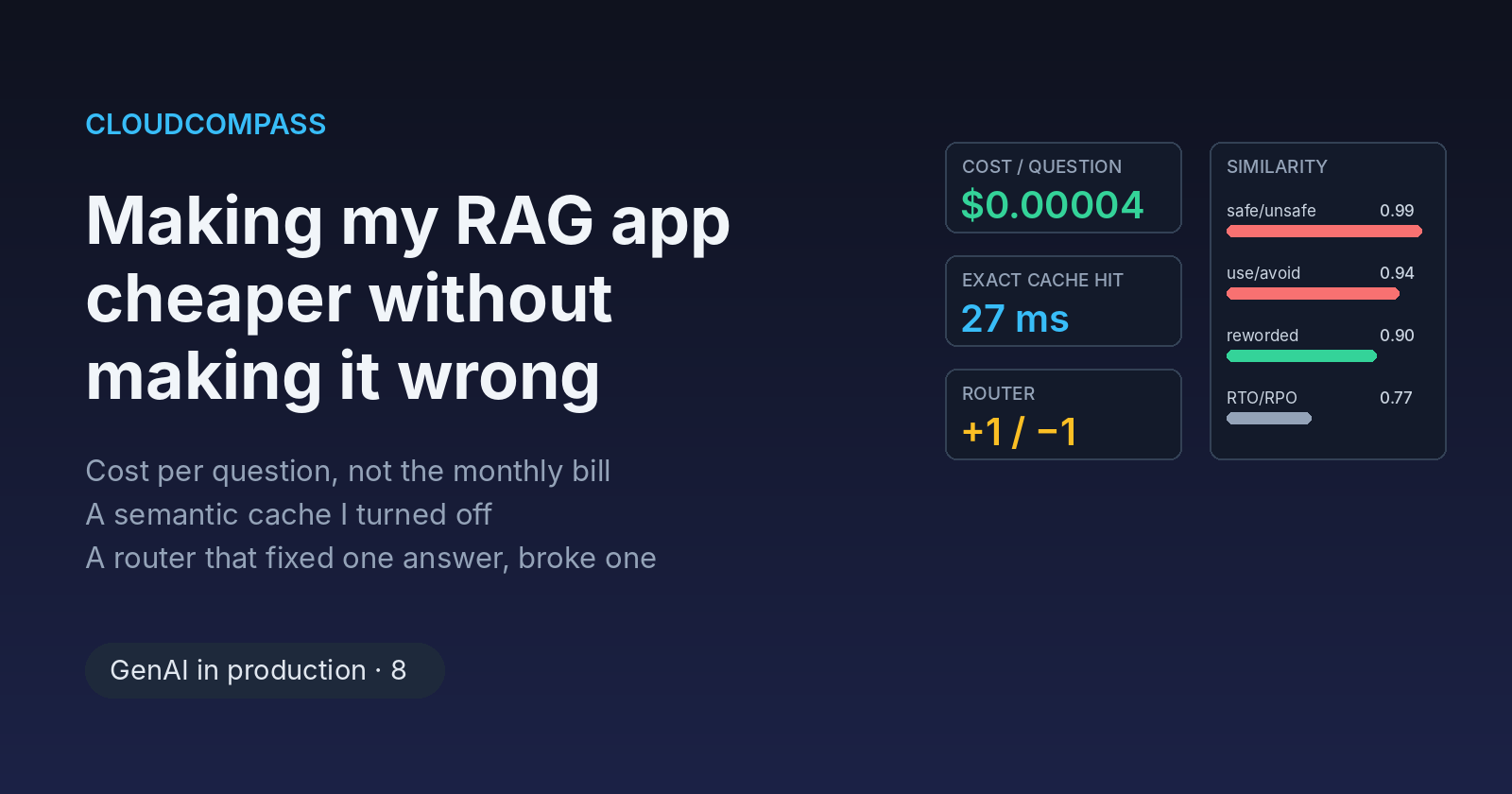
Splitting cost per question into variable token spend ($0.00004 on Nova Micro) versus fixed infrastructure ($40 to $60 a month) keeps low-volume teams from over-optimizing prompts while an always-on database dominates the bill. Pricing local evaluation runs against hosted production rates so context growth shows up as a cost regression in PR review is also a very practical habit.
Namespacing the exact cache under a composite hash of model, prompt version, retrieval settings, and corpus fingerprint eliminates stale-answer invalidation bugs cleanly. Treating a semantic cache as a binary classifier tested against labeled near-miss pairs—rather than guessing a cosine threshold—explains why turning it off is often safer than shipping a fluent wrong answer.
Thanks, glad the cost split was useful. It surprised me too: at low volume the always-on platform costs about fifty times the tokens.
Curious whether you've run a semantic cache in production. Did you find an embedding model, or a check like a reranker or exact-entity match, that handles negation well enough to keep it on?
Ahmet Özel
Splitting cost per question into variable token spend ($0.00004 on Nova Micro) versus fixed infrastructure ($40 to $60 a month) keeps low-volume teams from over-optimizing prompts while an always-on database dominates the bill. Pricing local evaluation runs against hosted production rates so context growth shows up as a cost regression in PR review is also a very practical habit.
Namespacing the exact cache under a composite hash of model, prompt version, retrieval settings, and corpus fingerprint eliminates stale-answer invalidation bugs cleanly. Treating a semantic cache as a binary classifier tested against labeled near-miss pairs—rather than guessing a cosine threshold—explains why turning it off is often safer than shipping a fluent wrong answer.