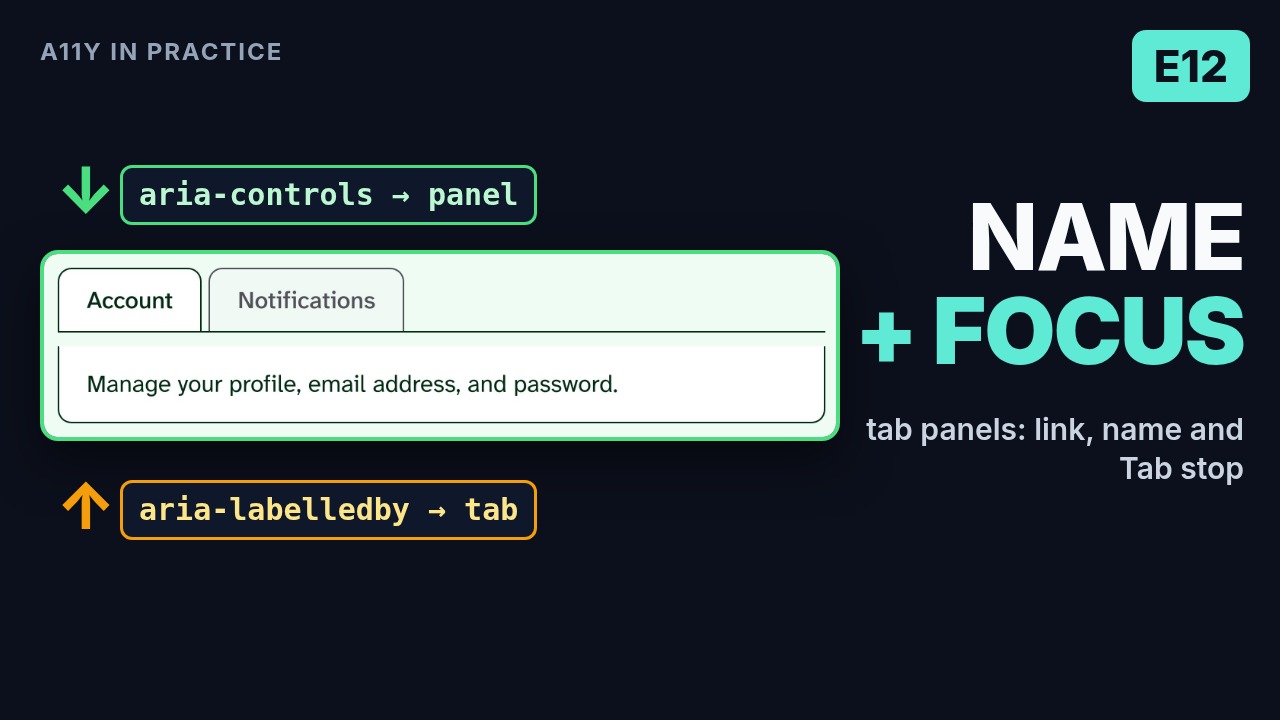
The two-directions framing is the clearest explanation of this I have seen — aria-controls points forward from the tab to the panel, and aria-labelledby points back so the panel takes its name from the tab's visible text. The broken-case examples land well too, especially the one where aria-controls is present but points at an ID that is not mounted anywhere: the attribute looks correct and the relationship still does not exist. I also appreciated the restraint in the reporting section — the APG as guidance rather than a WCAG requirement, and reporting the observed problem instead of counting missing attributes. The tabindex=0 decision table for text-only panels versus panels whose first content is focusable is something I will keep in mind the next time I build tabs.
Thanks, really glad the two-directions framing clicked. The unmounted-ID case is the one I see most in real audits, because the markup looks right in the source and only breaks at runtime, so checking the accessibility tree (or listening with VoiceOver) is the only reliable test. And yes, keeping APG as guidance rather than a WCAG requirement matters a lot when writing up findings. Thanks for reading!
OneLifeVibe
The two-directions framing is the clearest explanation of this I have seen — aria-controls points forward from the tab to the panel, and aria-labelledby points back so the panel takes its name from the tab's visible text. The broken-case examples land well too, especially the one where aria-controls is present but points at an ID that is not mounted anywhere: the attribute looks correct and the relationship still does not exist. I also appreciated the restraint in the reporting section — the APG as guidance rather than a WCAG requirement, and reporting the observed problem instead of counting missing attributes. The tabindex=0 decision table for text-only panels versus panels whose first content is focusable is something I will keep in mind the next time I build tabs.