FeedDiscussion
"Locker-room mathematics" for parameter counts is a fair description of how model selection often sounds.
The practical argument against size-first is that for most production tasks the model is not the bottleneck. In anything retrieval-shaped, a 7B with the right passage in context beats a 405B with the wrong one, and the gap is not close. Parameter count buys you capability on the hard tail; it does nothing for the far more common failure where the evidence never arrived.
The other cost worth naming is that bigger models make everything slower to iterate on, so you run fewer experiments per week. That compounds against you far faster than a few benchmark points compound for you.
Worth pushing on the 405B-vs-Pythia example a bit further: that LLaMA was 4-bit quantized while the Pythia models weren't, and outlier features (the ones LLM.int8() had to special-case) get more pronounced as models scale up. Naive quantization degrades a big model's effective capability more than it does a small one's, so there's a second confound sitting right on top of the ones already listed — a fair size comparison needs matched precision, not just matched task. Ran into this exact trap comparing an MXFP8 128GB local model against smaller full-precision ones; had to control for the quantization scheme before any size conclusion was trustworthy.
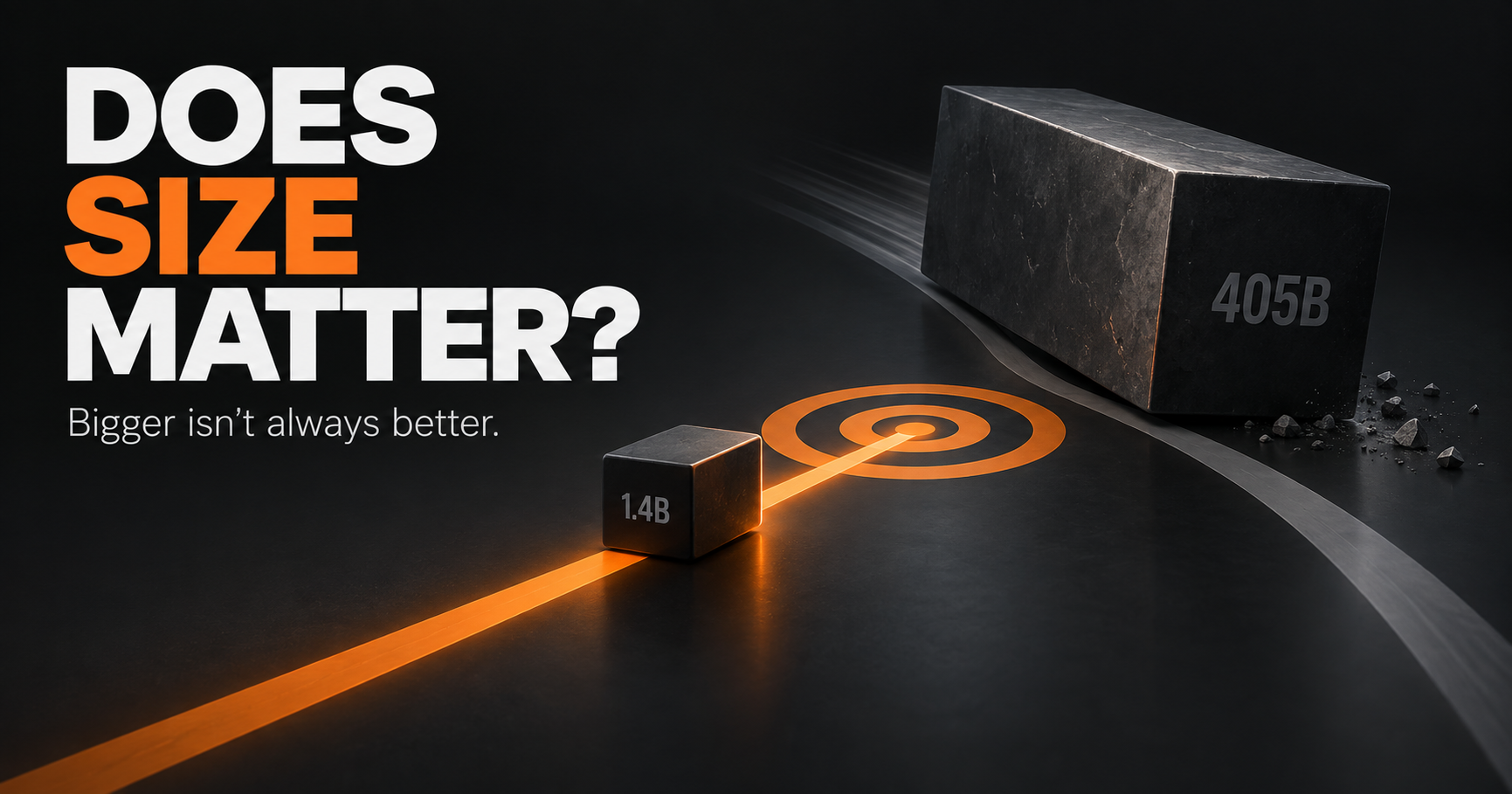
This article highlights something that is easy to overlook in the AI conversation. Bigger models often get the spotlight, but the real breakthrough comes when we focus on building systems that are efficient, practical, and accessible.
A model’s value is not only measured by how much data it can process or how many parameters it has. It’s measured by whether it can solve a real problem, fit into a workflow, and create meaningful outcomes for people.
Sometimes the smartest solution is not the largest one, but the one that is thoughtfully optimized for its purpose. This mindset feels especially important as AI moves from research labs into everyday applications.
Great perspective. The next generation of AI innovation will likely come from better design decisions, not just bigger machines.