Feed
Discussion
One Index, Many Writers: Avoiding Git Merge Conflicts with Deterministic Write Areas
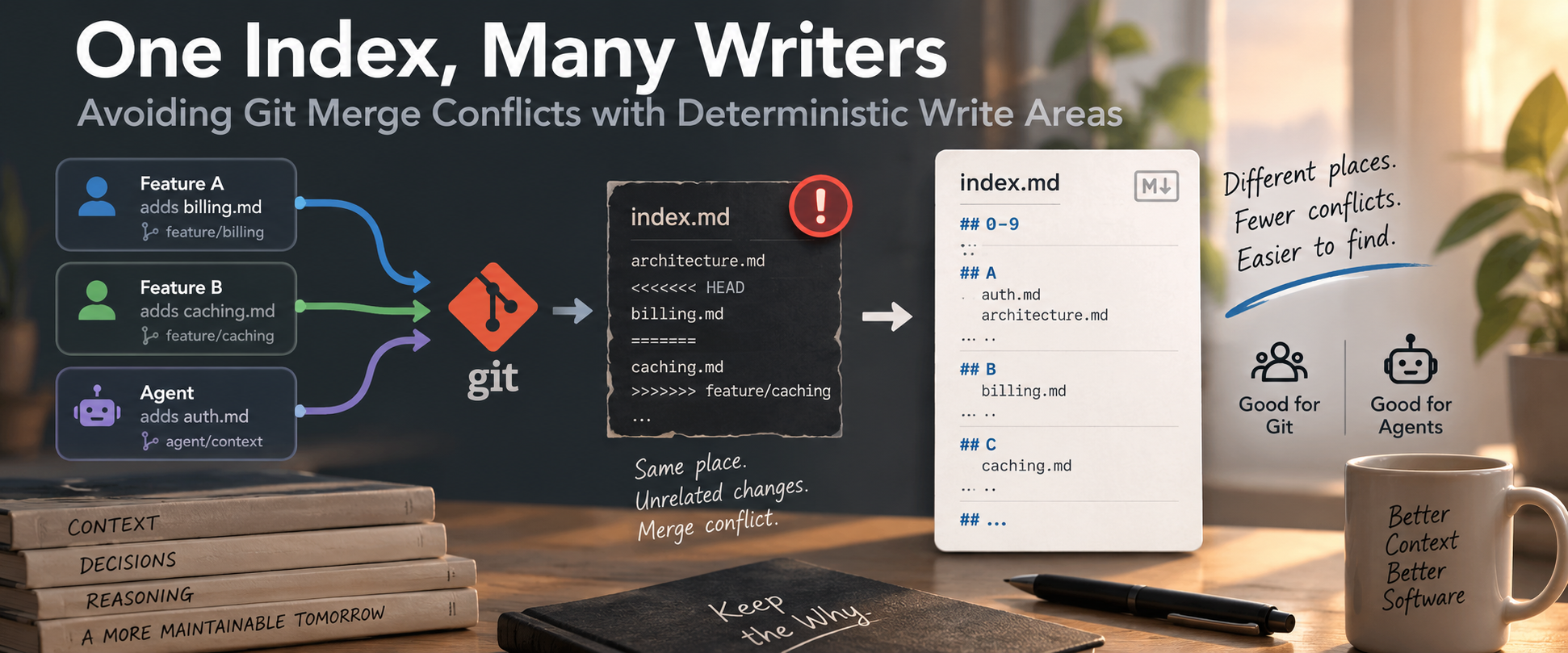
While working on Keep the Why, I ran into a very ordinary Git problem. There is one shared context/index.md. Developers and coding agents can add new context files in different branches. The changes a
#git#github#gitlab#devsecops#aiengineering#codingagents#software-architecture#developer-tools#opensource#mergeconflicts#keepthewhy
Responses
Markdown supported · ⌘↵ to post
The interesting part is that this treats Git conflicts as a write-allocation problem, rather than trying to make the merge process smarter. Pre-allocating deterministic regions gives independent writers different merge anchors, which is especially useful when agents are making changes concurrently.
I also like the agent-retrieval side effect. Predictable sections reduce the search space before an agent has to load the actual context, so the same structure improves both merge behavior and retrieval efficiency. It’s a good example of a small repository convention solving what initially looks like two separate problems.