VViktorinwarrenops.hashnode.dev·1d ago · 7 min readAlerting when a RabbitMQ queue has no consumersOriginally published at warrenops.io. A queue with messages and zero consumers is the quietest outage there is. Nothing errors. Producers publish happily. The dashboard shows the broker green. Then th00
IUItachi Uchihainaligoren.hashnode.dev·1d ago · 1 min readInvestigating consumer lag without guessworkHi everyone, we’ve created a new project called Broka that supports Kafka, RabbitMQ, Redis, ActiveMQ Artemis, and Memcached. If you don't mind, I’d love to walk you through it with a quick guide. You 00
VViktorinwarrenops.hashnode.dev·2d ago · 8 min readReading the x-death header: which queue rejected the message, and whyOriginally published at warrenops.io. Every message in a dead-letter queue carries its own incident report. RabbitMQ writes it into the x-death header when it dead-letters the message. Most people hav00
CACiphemic academiainciphemicacademia.hashnode.dev·2d ago · 13 min readKafka vs. RabbitMQ vs. SQS: The Message Queue That Started at 400,000 Messages a SecondKafka vs. RabbitMQ vs. SQS: The Message Queue That Started at 400,000 Messages a Second Kafka exists because RabbitMQ couldn't keep up. LinkedIn's engineers, back when the company was building the act00
VViktorinwarrenops.hashnode.dev·4d ago · 7 min readHow to replay dead-lettered messages in RabbitMQOriginally published at warrenops.io. A dead-letter queue is filling up, the bug that caused it is fixed, and now 300 messages have to go back to where they came from. This is what your options are, w00
MTMuhammad Tahirinmtdeveloper.hashnode.dev·4d ago · 14 min readDesigning High-Throughput Event-Driven Microservices with Kafka and RabbitMQThis article was originally published on Muhammad Tahir's Portfolio. Introduction & Industry Context In the landscape of modern software architecture, event-driven microservices have transitioned from00
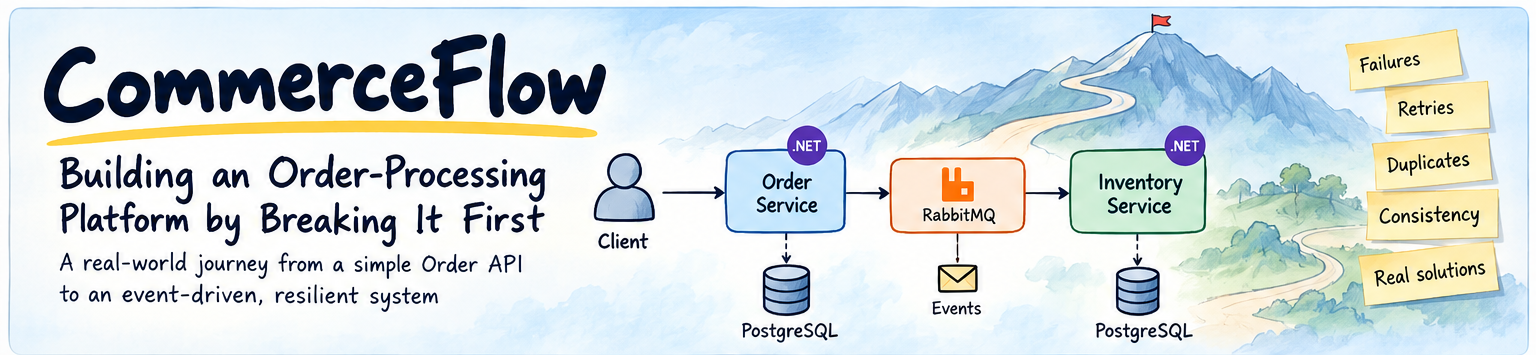
RBRakesh Bhandarkarinrakesh-code-lab.hashnode.dev·Sep 24 · 11 min readCommerceFlow: What I’m building, how an order moves through the system, and the engineering problems shaping the architecture CommerceFlow is an order-processing platform I’m building from the ground up. The starti02B
TITelcoEdge Inc.intelcoedgeinc.hashnode.dev·Sep 8 · 9 min readKafka vs RabbitMQ for Telecom Event Processing: Which Architecture Fits Better?Modern telecom platforms generate an enormous number of events. A subscriber activates a service, a SIM changes state, a device establishes a session, a usage record is generated, a payment is complet00
OOutworkTechinoutworktech.hashnode.dev·Aug 31 · 10 min readMessage Queues Explained: When to Use Kafka, RabbitMQ, or SQSAs applications become more complex, handling every operation synchronously can quickly create performance and reliability problems. A user places an order, a payment needs to be processed, an email n00
JSJay Solankiinunderstandingsystems.hashnode.dev·Jul 25 · 6 min readWhy RabbitMQ Instead of Kafka? Choosing the Right Tool for the ProblemSeries: Building a Distributed Scientific Data Pipeline (Part 2) In the previous article, I explored why my Distributed Scientific Data Pipeline (DSDP) needed a message broker in the first place. Tha00