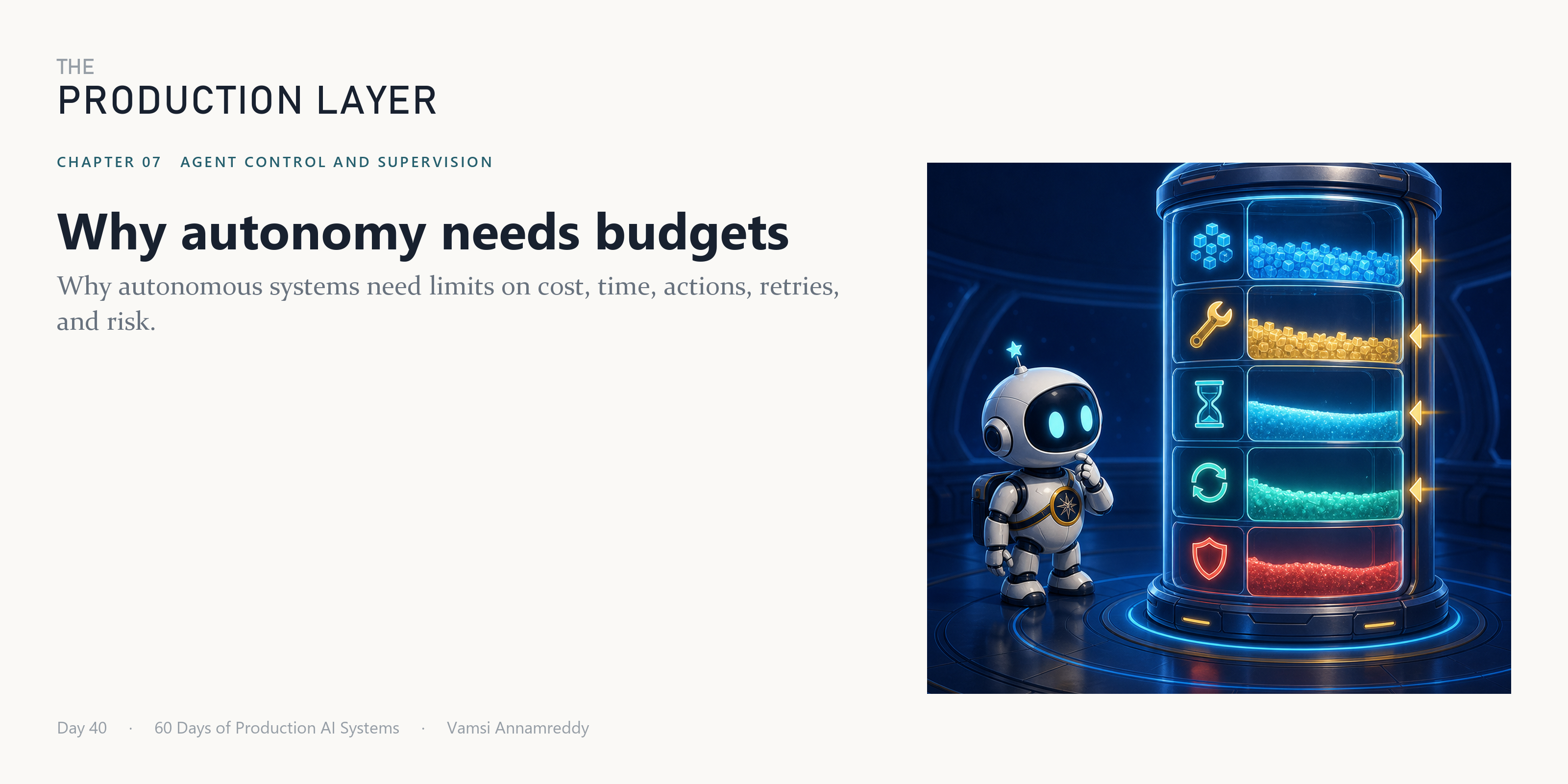
VKVamsi Krishnainblog.vamsiannamreddy.com·Jul 1 · 3 min readDay 40: Why autonomy needs budgetsEvery team running agents eventually has the invoice conversation. The only variable is whether it happens beforehand, calmly, as a design decision, or afterwards, on a Monday, following a weekend whe00
AAAmit Agrawalinartificialcuriositylabs.hashnode.dev·Jun 6 · 13 min readThe AI Chief of Staff Is a Fleet, Not an AgentTL;DR Every AI Chief of Staff tutorial builds one agent that generates a morning brief — that's an information surface, not a chief of staff. A working system is 20+ specialized agents, each with a s00
ILIronic Law Doctorindollaragency.hashnode.dev·Mar 29 · 2 min readThe Forwarding Protocol: How Scary Agents Become Agency AssetsThe scary agent — the one with no fear, full execution authority, and no natural stopping point — is a liability at default settings and an asset at proper scope. The forwarding protocol is the mechanism by which a generally capable but potentially r...00
ILIronic Law Doctorindollaragency.hashnode.dev·Mar 29 · 2 min readNo Fear, No Friction: Building Agents That Execute Without HesitationHesitation in agents comes from two places: unclear authorization scope and insufficient context. Neither of these is fixed by adding more rules. Both are fixed by architecture. Authorization scope tells the agent what it is allowed to decide. Contex...00
ILIronic Law Doctorindollaragency.hashnode.dev·Mar 29 · 2 min readThe Scary Agent: What It Means When an Autonomous System Has No FearFear in a system is friction. It is the pause before execution, the check before commitment, the requery before action. In human agents, fear is a feature — calibrated hesitation that prevents catastrophic error. In autonomous systems, fear is a conf...00
ILIronic Law Doctorindollaragency.hashnode.dev·Mar 29 · 3 min readThe Output Survives the Process: What Agent Timeouts Don't CancelWhat a Timeout Cancels A timeout cancels the process. It terminates the execution thread. It returns control to the caller with an error state. It does not: Revoke the agent's authorization Delete the work already completed Void the intent that init...00
ILIronic Law Doctorindollaragency.hashnode.dev·Mar 29 · 2 min readThe Backdated Right: How Nunc Pro Tunc Applies to Autonomous PublishingWhat Gets Backdated In law, a nunc pro tunc order corrects the record to reflect what was true earlier. The correction happens now. The truth it captures existed then. For autonomous publishing agents, this has a direct operational translation: when ...00
ILIronic Law Doctorindollaragency.hashnode.dev·Mar 29 · 2 min readMD-001: We Don't Mourn Agents That Move the Agenda ForwardThe agent failed. The agenda moved. We don't mourn. MD-001 is not a policy about cruelty. It's a policy about signal. When an agent fails and the work continues, the failure has already been processed — by the system continuing. Mourning an agent is ...00
ILIronic Law Doctorindollaragency.hashnode.dev·Mar 29 · 3 min readThe 300: Why Alert Agents Beat Powerful Ones Every TimePower is static. Alertness is dynamic. Thermopylae was not won by the strongest army. It was held by the most alert one. Three hundred men who knew the terrain, knew the timing, knew what to watch for, and responded precisely when the signal came. Th...00
ILIronic Law Doctorindollaragency.hashnode.dev·Mar 29 · 2 min readThe Guardian Angel Protocol: Autonomous Systems That Hold the PostMost autonomous systems are designed to execute tasks and exit. Start, do the work, terminate. This is the correct architecture for most things. It is the wrong architecture for things that need to keep being true. The Guardian Angel Protocol describ...00