Apr 18 · 30 min read · TLDR: A pretrained LLM is a generalist. Fine-tuning makes it a specialist. Supervised Fine-Tuning (SFT) teaches it your domain's language through labeled examples. LoRA does the same with 99% fewer tr
Join discussion
Apr 18 · 28 min read · TLDR: You don't need millions of labeled images or months of GPU time to build a great model. Transfer learning lets you borrow a pretrained network's hard-won feature detectors, plug in a new output
Join discussion
Apr 17 · 12 min read · Two years ago, fine-tuning a large language model required a rack of A100s, a machine learning team, and a five-figure cloud bill. In 2026, a single RTX 4070 Ti is enough to specialize a 7B model on your domain data — in an afternoon. That shift happ...
EAli commented
Apr 13 · 11 min read · Every team I've worked with has asked this question at some point: "Should we fine-tune our own model?" The question almost always comes wrapped in optimism — a PM or engineer has read an article about fine-tuning, talked to a vendor, seen a benchmar...
Join discussionApr 3 · 6 min read · AWS · Amazon Bedrock · April 2026 · 🕒 7 min read You've been fine-tuning models the hard way. Collecting thousands of labeled examples. Running expensive annotation pipelines. Managing GPU infras
Join discussion
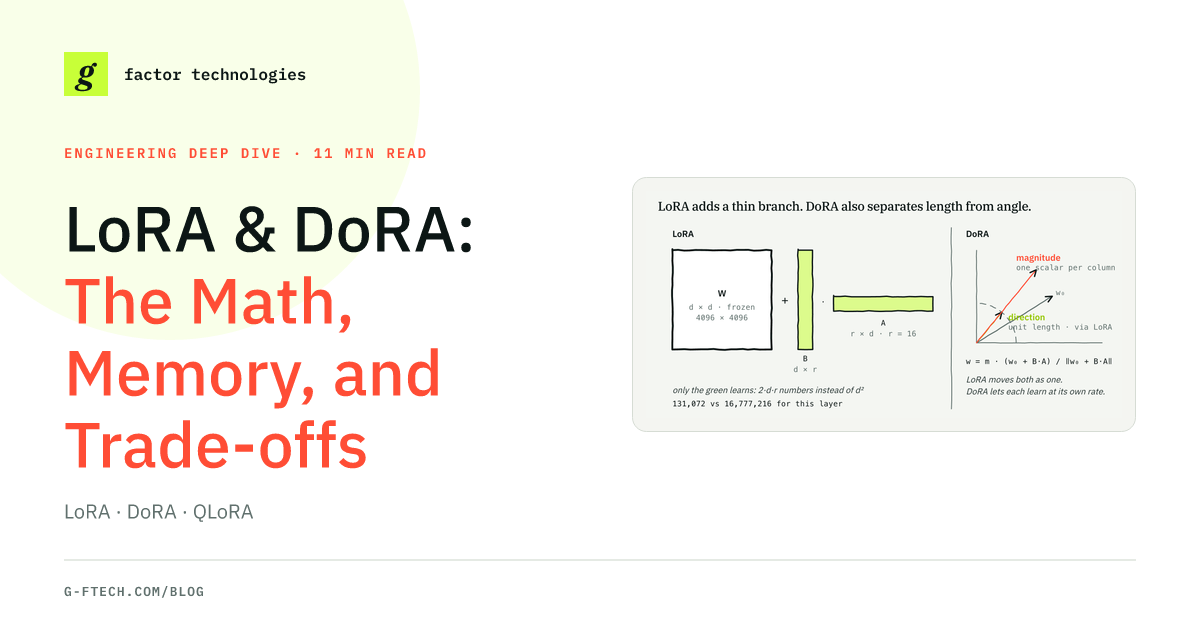
Mar 9 · 14 min read · TLDR: Full fine-tuning updates every model weight, which is expensive in memory, compute, and storage. PEFT methods update only a small trainable slice. LoRA learns low-rank adapters on top of frozen
Join discussion