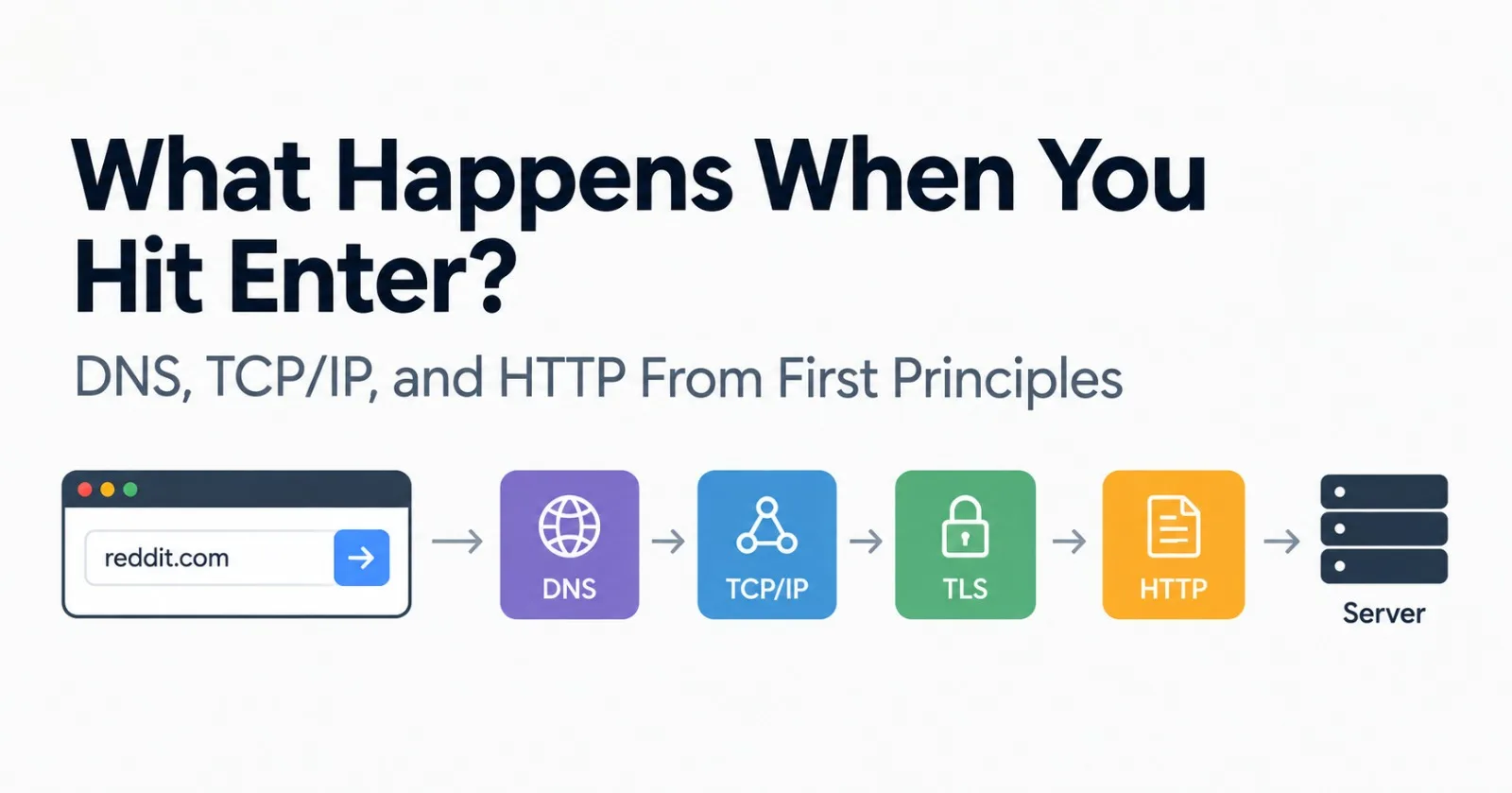
May 18 · 14 min read · You type a URL, press Enter, and a webpage appears in under a second. But have you ever wondered what's happening underneath — in the infrastructure that actually moves your request from your laptop t
Join discussion
Feb 14 · 4 min read · TCP VS UDP While establishing a connection between server and client, there must be some sort of rules to follow, some protocol should be there. TCP (Transmission Control Protocol) and UDP (User Datagram Protocol) are two such protocols, either of th...
Join discussion
Feb 12 · 5 min read · Introduction. Whenever we use the internet like opening a website, watching videos or sending messages, data is being transferred from one computer to another. But the internet does not send data as one big file. The data is divided into small packet...
Join discussion
Feb 1 · 8 min read · The first time I heard “TCP 3‑way handshake,” it sounded like some deep networking ritual. But the truth is simpler: TCP is just a set of rules that lets two computers talk reliably—even though the internet itself is messy (packets can get lost, dupl...
Join discussionFeb 1 · 2 min read · TCP 3-Way Handshake Process: The TCP 3-Way Handshake is a process used by the Transmission Control Protocol (TCP) to establish a reliable connection between a client and a server before data transfer. It ensures that both sides are synchronized and r...
Join discussionFeb 1 · 4 min read · When you open a website, send an email, or download a file, a lot happens behind the scenes. Data travels across the internet through many networks and devices before reaching its destination. But how does the internet make sure that this data arrive...
Join discussionFeb 1 · 2 min read · The internet operates smoothly because it follows a set of rules for sending information, much like traffic rules ensure the smooth movement of cars on roads. Two key protocols that help manage this data flow are TCP (Transmission Control Protocol) a...
Join discussionJan 31 · 4 min read · Introduction Welcome back to the "From Wire to Web" series! Part 1: We built the road (Undersea Cables). Part 2 & 3: We found the address using the GPS (DNS). Now, we need to actually drive to the destination to deliver the message. We are drivin...
Join discussion