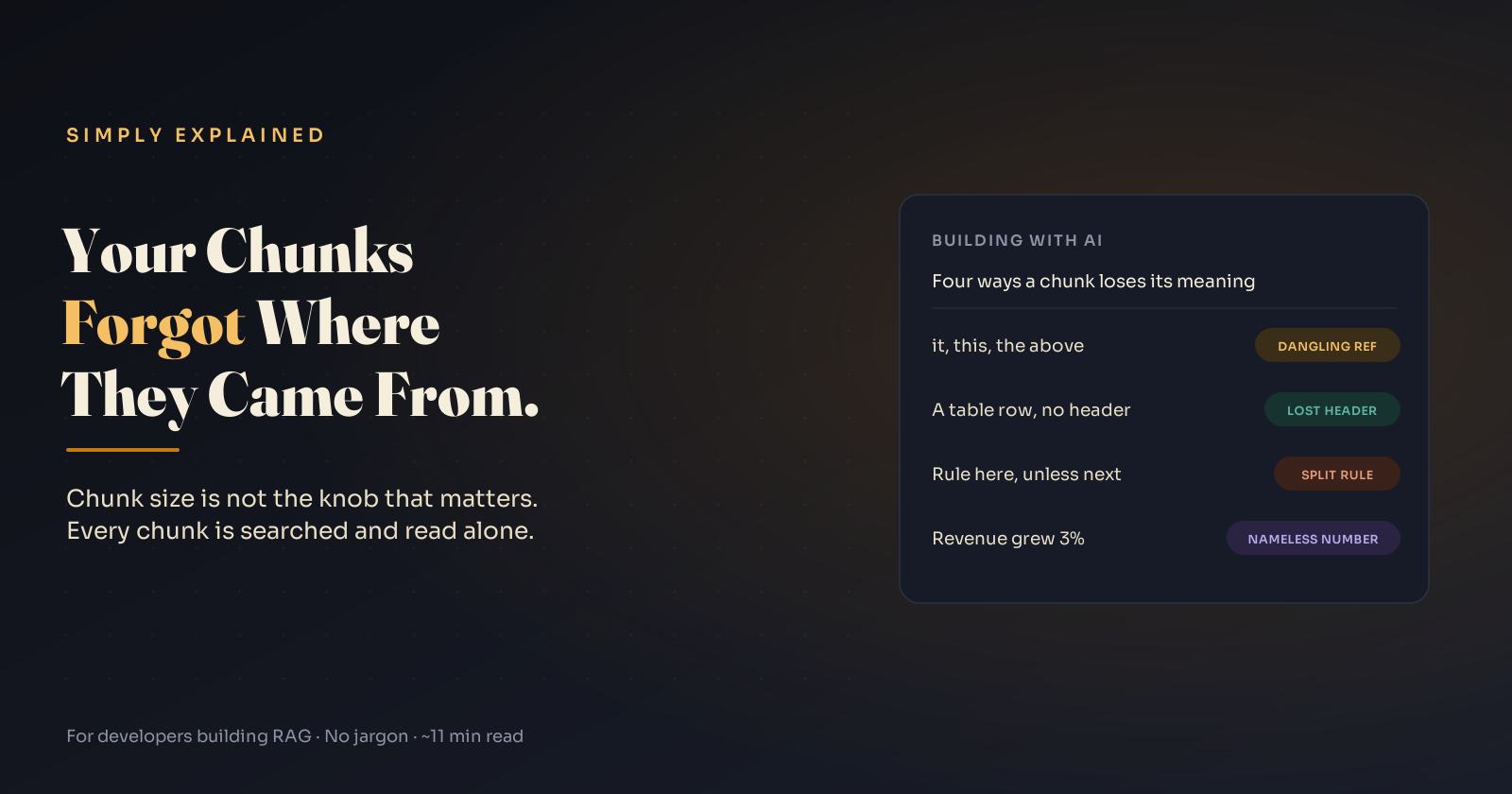
Jjaberadam200117h ago · 9 min readRAG Chunking: Why Chunk Size Is the Wrong KnobYou've swept chunk size from 256 to 1024 tokens. You tried 20% overlap, then 50%. You swapped in a semantic splitter. Your eval score moved a point and a half, and the answers that were wrong are mostsimplyexplained.hashnode.dev
GGalaxyonKnowledgeOct 2 · 5 min readEnterprise Systems Integration & Production RAG Frameworks3.1 The Production Chasm: Why Sandbox Conversational AI Models Break at Scale In the engineering lifecycles of contemporary corporate environments, moving an artificial intelligence system from a succgalaxyonknowledge.hashnode.dev
SSubramanya M RaoSep 1 · 33 min readHow We Built Sahaayak: A Voice-First AI Copilot in 9 DaysMost AI hackathon demos stop at three steps: upload a collection of documents, connect them to a language model, put a chat interface in front of the result. That is enough to demonstrate retrievsubramanyarao.hashnode.dev
SSynfinity Dynamics Pvt LtdAug 24 · 9 min readWhy Retrieval-Augmented Generation (RAG) Is the Future of Enterprise AIEnterprise adoption of AI is accelerating across nearly every industry, from customer support to legal review to financial analysis. But as companies move past experimentation and into production, the1synfinitydynamics.hashnode.dev
RRajshreeAug 22 · 25 min readYour RAG Isn't Broken. Your Retrieval Pipeline Is.author: "RAJश्री" A practical guide to diagnosing and improving Retrieval-Augmented Generation systems Most RAG systems don't fail because the LLM can't answer the question. They fail because the LLMrjshree.hashnode.dev
JJaival SutharAug 17 · 21 min readKnowledge Vault: Finding Where RAG Retrieval Actually FailsBuilding a RAG system is relatively easy to demonstrate. Building one where you can measure why it fails, reproduce the failure, and identify which stage caused it is a very different engineering prob11Kjaivalsuthar.hashnode.dev
PPulkit KushwahaAug 12 · 11 min readThe Most Important Decision in AI Isn't Choosing the ModelThe Most Important Decision in AI Isn't Choosing the Model Engineers love comparing models. GPT versus Claude. Claude versus Gemini. Gemini versus Llama. Yet after working on real-world AI systems, I'2pulkitkushwaha.hashnode.dev
RRedwan RahmanAug 10 · 8 min readThe Ruler Can Change Too: Navigating Judge Drift in Production AI EvaluationThe Monday Morning Regression It is Monday morning. You arrive at your desk to find that production monitoring has flagged a sudden, severe degradation in your core Retrieval-Augmented Generation (RAG12Knirizan.hashnode.dev
BBhuvesh DhimanAug 9 · 1 min readRAG's top-k retrieval has a black box problem, and it isn't fixed by a bigger modelA vector search returns the nearest chunks by embedding distance, hands them to the model, and stops. Nobody asks why those chunks and not the ones one rank lower. When retrieval brings back the wrongblog.bhuveshdhiman.com
PPulkit KushwahaAug 7 · 12 min readThe Most Underrated Skill in AI Isn't Prompt EngineeringThe Most Underrated Skill in AI Isn't Prompt Engineering As AI models become smarter, the challenge is no longer what to ask. The challenge is deciding what the model should know before it answers. F2pulkitkushwaha.hashnode.dev