Apr 1 · 8 min read · Node.js WebSockets in Production: Socket.IO vs ws, Scaling, and Reconnection Strategies WebSockets break the HTTP request-response model. Once you open a WebSocket connection, the server can push data to the client at any time — no polling, no long-p...
Join discussionMar 30 · 8 min read · Node.js WebSockets in Production: Socket.io, ws, and Scaling to Multiple Nodes WebSockets are deceptively simple to get working locally and surprisingly difficult to operate correctly in production. A single Node.js process handles connections fine. ...
Join discussionMar 29 · 12 min read · Introduction I was building a real-time chat system designed to handle 100K concurrent WebSocket connections at 25K+ messages per second. The architecture was a symmetric dual-stack — two identical se
Join discussion
Mar 29 · 8 min read · The first bug in the live coaching system was not transcription quality. It was startup order. I originally let audio frames flow as soon as the websocket connected, which meant the first chunks could arrive before the GPT-4o Realtime session had act...
Join discussion
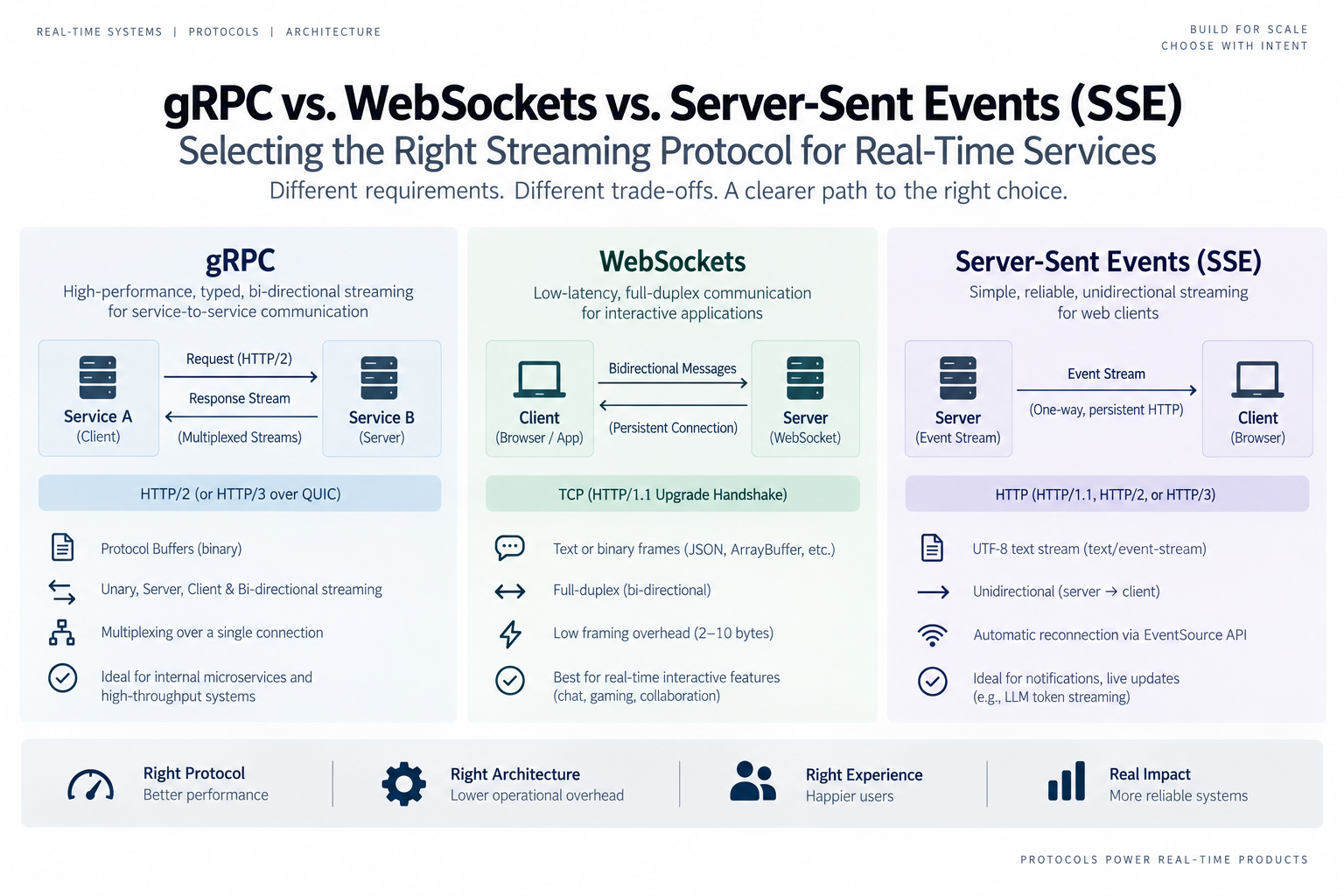
Mar 28 · 23 min read · TLDR: 🔌 WebSockets = bidirectional persistent channel — use for chat, gaming, collaborative editing. SSE = one-way server push over HTTP with built-in reconnect — use for AI streaming, live logs, notifications. Long Polling = held HTTP requests — th...
Join discussionMar 18 · 4 min read · Your AI assistant is mid-sentence explaining a complex debugging strategy. The user refreshes the page. The response starts over from the beginning, or worse, vanishes entirely. This isn't a model pro
Join discussion
Mar 16 · 4 min read · When your real-time chat application grows from a handful of concurrent users to tens of thousands, the architecture decisions you made on day one start to crack. Single-server WebSocket setups hit co
Join discussion